opensource.google.com

Menu
Showing posts with label developer tools. Show all posts

A new pkg.go.dev API for Go

Friday, June 12, 2026

Access to Go metadata has been an everpresent need for the Go community. Since its launch, pkg.go.dev has served as a central hub for Go package documentation and discovery. While we initially prioritized providing this comprehensive access via a web interface, the need for streamlined programmatic access has become increasingly clear.

Structured API access has been one of the most highly requested features for pkg.go.dev for a while now. Developers building tools, IDE integrations, automated workflows, and other systems have had to rely on inconsistent and fragile scraping methods. By providing a formal API, we can provide fast and efficient access to required data. This foundation also sets Go up for the future of AI-assisted coding. Large language models and agents can access the context necessary to reason about the Go ecosystem with greater precision and accuracy.

Empowering Tool Builders

Our goal with this API is to reduce the technical churn for builders and innovators. By offering structured JSON metadata, we address the following use cases:

  • Search and Discovery: The API enables fast and efficient search across the entire Go module ecosystem.
  • Driving AI Innovation: As AI-assisted coding evolves, LLMs and agents need precise context. This API provides the data required for agents and models to reason deterministically about Go packages.

The Service Interface

Built for stability and efficient caching, the API uses a stateless, GET-only architecture. Primary endpoints are currently hosted under the v1beta path. Following a period of feedback from the Go community and confirmed stability, we intend to transition toward a formal v1 release.

For a complete interactive reference of all endpoints, query parameters, and response shapes, see pkg.go.dev/api. The machine-readable API contract is also published directly at pkg.go.dev/v1beta/openapi.yaml.

Endpoint Description
/v1beta/imported-by/{path} Paths of packages importing the package at {path}.
/v1beta/module/{path} Information about the module at {path}.
/v1beta/package/{path} Information about the package at {path}.
/v1beta/packages/{path} Information about packages of the module at {path}.
/v1beta/search/search?q={query} Search results for a given query.
/v1beta/symbols/{path} List of symbols declared by the package at {path}.
/v1beta/versions/{path} Versions of the module at {path}.
/v1beta/vulns/{path} Vulnerabilities of the module or package at {path}.

An example of retrieving package information is shown below:

curl https://pkg.go.dev/v1beta/package/github.com/google/go-cmp/cmp | jq
{
  "modulePath": "github.com/google/go-cmp",
  "version": "v0.7.0",
  "isLatest": true,
  "isStandardLibrary": false,
  "goos": "all",
  "goarch": "all",
  "path": "github.com/google/go-cmp/cmp",
  "name": "cmp",
  "synopsis": "Package cmp determines equality of values.",
  "isRedistributable": true
}

A Reference Implementation

To demonstrate how to interact with our API, we are providing a reference CLI implementation: pkgsite-cli. This implementation serves as a practical example for developers looking to build their own integrations, showing how to handle the data directly from the terminal. Note, as the API continues to evolve, the interface and behavior of this CLI may change.

You can use it to search for packages or inspect symbols without leaving your shell:

go install golang.org/x/pkgsite/cmd/internal/pkgsite-cli@latest

pkgsite-cli search "uuid"
github.com/google/uuid
  Module:   github.com/google/uuid@v1.6.0
  Synopsis: Package uuid generates and inspects UUIDs.
... more


pkgsite-cli package github.com/google/go-cmp/cmp
github.com/google/go-cmp/cmp
  Name:      cmp
  Module:    github.com/google/go-cmp
  Version:   v0.7.0 (latest)
  Synopsis:  Package cmp determines equality of values.

pkgsite-cli package --symbols github.com/google/go-cmp/cmp
github.com/google/go-cmp/cmp
  Name:     cmp
  Module:   github.com/google/go-cmp
  Version:  v0.7.0 (latest)
  Synopsis: Package cmp determines equality of values.

Symbols:
  type Indirect struct{}
  type MapIndex struct{}
  type Option interface{}
  ... more

Looking Ahead

While we prioritize stability for our new /v1beta endpoints, we are eager to hear how open source communities use these resources to solve real-world problems.

We look forward to your feedback via our issue tracker and to seeing the tools you’ll build next.

Google joins the Eclipse Foundation as a strategic member to accelerate AI-integrated developer tools

Wednesday, June 10, 2026

A simple image with the Google logo a plus sign and the Eclipse Foundation logo

Collaboration with the Eclipse Foundation will support open infrastructure for AI-integrated developer platforms like Google Antigravity, while advancing broader open source security and regulatory compliance initiatives

As of April 2026, Google has joined the Eclipse Foundation as a Strategic Member, reflecting the company's continued investment in open source technologies and modern developer infrastructure.

As part of this collaboration, Google will additionally sponsor Open VSX and is among the first adopters of the recently announced Open VSX Managed Registry service. Open VSX is the open source, vendor-neutral extension registry for tools built on the VS Code™ extension API. It powers a rapidly growing ecosystem of AI-integrated IDEs, cloud development environments, and developer platforms, including Google Antigravity, AWS's Kiro, Cursor, and, Windsurf among many others.

As a Strategic Member, Google will participate in the Eclipse Foundation's Board of Directors and Technical Advisory Council, helping guide the technical and strategic direction of one of the world's leading open source software foundations.

"The industry is feeling the massive turning point as AI continues to change how developers write, deploy, and maintain software," said amanda casari of Google's Open Source Programs Office and new Eclipse Board member. "Joining The Eclipse Foundation as a Strategic Member ensures that the next generation of AI-integrated developer experiences—including platforms like Google Antigravity—are built in partnership with transparent, vendor-neutral foundations. Open registries, like Open VSX, are critical infrastructure which keep the global developer ecosystem open to everyone."

Google and the Eclipse Foundation share a deep history, having collaborated across numerous initiatives since 2006. This Strategic Membership elevates the relationship and support critical to modern initiatives like Open VSX, Open Regulatory Compliance (ORC), and Adoptium.

"Google has played a pivotal role in open source innovation for two decades," said Mike Milinkovich, Executive Director of the Eclipse Foundation. "Their decision to join as a Strategic Member reflects the growing importance of open collaboration in supporting global regulatory compliance efforts, strengthening open source infrastructure, securing supply chains, and advancing the next generation of AI-integrated developer platforms."

The Eclipse Foundation continues to see explosive growth as adoption accelerates across AI-integrated developer tooling and cloud development environments. The Open VSX registry now scales to meet massive global demand:

  • 300 million+ downloads per month
  • 200 million requests during peak daily traffic
  • 12,000+ hosted extensions from over 8,000 publishers.

Explore the new Learn Kubernetes with Google website!

Thursday, November 17, 2022

As Kubernetes has become a mainstream global technology, with 96% of organizations surveyed by the CNCF1 using or evaluating Kubernetes for production use, it is now estimated that 31%2 of backend developers worldwide are Kubernetes developers. To add to the growing popularity, the 2021 annual report1 also listed close to 60 enhancements by special interest and working groups to the Kubernetes project. With so much information in the ecosystem, how can Kubernetes developers stay on top of the latest developments and learn what to prioritize to best support their infrastructure?

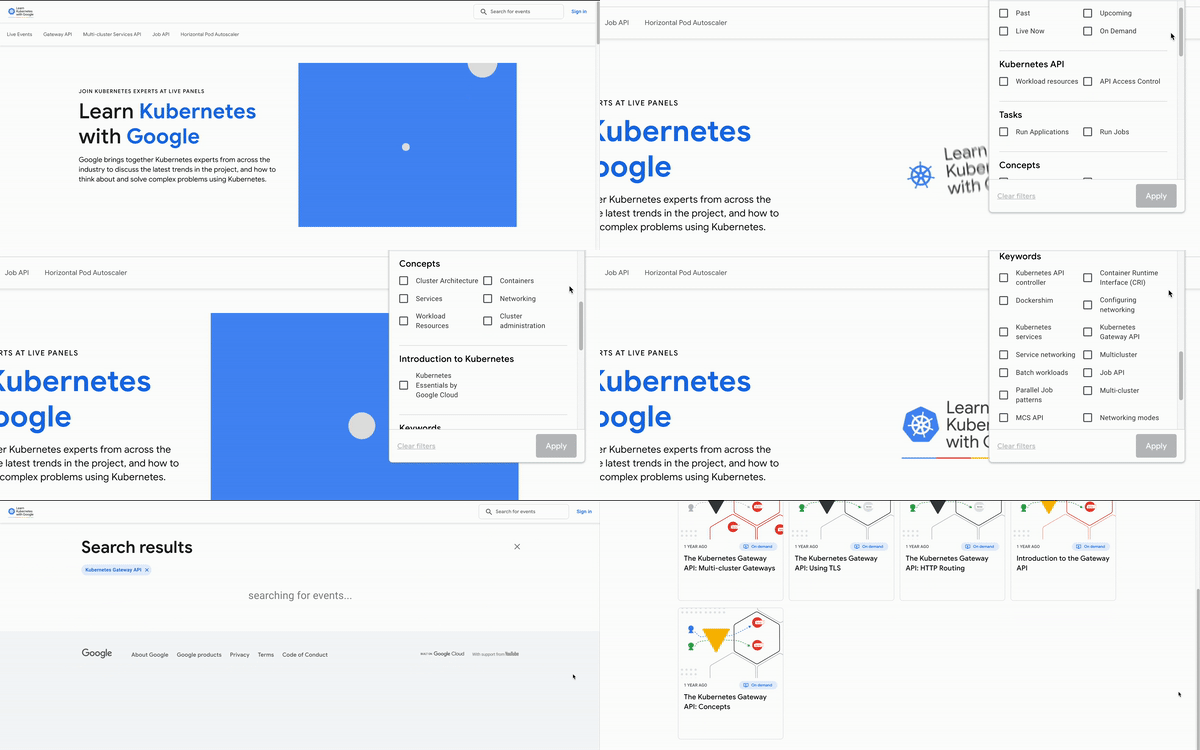
The new website Learn Kubernetes with Google brings together under one roof the guidance of Kubernetes experts—both from Google and across the industry—to communicate the latest trends in building your Kubernetes infrastructure. You can access knowledge in two formats.

One option is to participate in scheduled live events, which consist of virtual panels that allow you to ask questions to experts via a Q&A forum. Virtual panels last for an hour, and happen once quarterly. So far, we’ve hosted panels on building a multi-cluster infrastructure, the Dockershim deprecation, bringing High Performance Computing (HPC) to Kuberntes, and securing your services with Istio on Kubernetes. The other option is to pick one of the multiple on-demand series available. Series are made up of several 5-10 minute episodes and you can go through them at your own leisure. They cover different topics, including the Kubernetes Gateway API, the MCS API, Batch workloads, and Getting started with Kubernetes. You can use the search bar on the top right side of the website to look up specific topics.
ALT TEXT
As the cloud native ecosystem becomes increasingly complex, this website will continue to offer evergreen content for Kubernetes developers and users. We recently launched a new content category for ecosystem projects, which started by covering how to run Istio on Kubernetes. Soon, we will also launch a content category for developer tools, starting with Minikube.

Join hundreds of developers that are already part of the Learn Kubernetes with Google community! Bookmark the website, sign up for an event today, and be sure to check back regularly for new content.

By María Cruz, Program Manager – Google Open Source Programs Office

.