opensource.google.com

Menu

Posts from August 2026

Securing the agentic era: Introducing formal verification for CEL

Tuesday, August 18, 2026

CEL Formal Verification header graphic

We are rapidly entering an era where AI agents can autonomously draft, refactor, and deploy policies that protect our users and our systems. But this velocity introduces a vital question: How do we trust AI-generated policies?

Unit tests may fail to cover the infinite set of possible inputs that occur in production; thus, an AI agent that overfits its policy to existing tests may fail spectacularly in production. To secure automated policy authoring, we must combine heuristic testing with mathematical proofs.

We are thrilled to announce the Common Expression Language (CEL) Formal Verification Framework is now available. Powered by the Z3 theorem prover, this framework allows you to prove the correctness of your CEL expressions and policies, serving as the ultimate safety net for the agentic policy.

Automated reasoning definitively answers questions like:

  • “Is there any combination of inputs that allows an unapproved request into production?”
  • “Are we absolutely certain this AI-refactored policy matches the original behavior?”
  • “Can a bad actor manipulate this rule to force an evaluation error?”

Formal verification establishes mathematical certainty across the infinite spectrum of inputs. Proven policies protect your users and system while giving auditors clear proof of compliance.

To see these capabilities in action, watch our video demonstrating how the CEL Verifier REPL catches subtle logic flaws in seconds:

Proving rules from the ground up

Getting started with formal verification doesn’t require learning complex architectures right away. You can evaluate simple standalone CEL expressions to catch edge cases that tests easily miss.

(Note: The examples below use our interactive REPL syntax—check out the REPL documentation to follow along!)

1. Catching logic bugs in simple expressions (Equivalence)

How do you guarantee a refactored rule behaves identically to the original? Suppose we have a policy that allows ports 80 or 443 in production. An agent might factor the is_prod check like so:

equiv
  (is_prod && port == 80) || (is_prod && port == 443) 
  <=>
  is_prod && port == 80 || port == 443

Because logical AND has a higher operator precedence than OR, the verifier immediately flags Violated, and outputs the exact exploit: in a non-production environment (is_prod = false), the rule mistakenly allows port 443. Fixing the grouping parentheses returns Verified.

2. Enforcing exhaustive guardrails (Validity)

This capability scales directly to use cases like Kubernetes Validating Admission Policies. Suppose an engineer writes a guardrail expression that assumes every request will either be on a low port (under 80) or a high port (over 1024):

valid request.port > 1024 || request.port <= 80

When we check validity (whether an expression holds true for all inputs), the verifier exhaustively searches the entire integer space, flags Violated, and outputs the exact counterexample:

[VIOLATED] Condition is not always true. Counterexample input:
  request.port = 81

3. Guaranteeing security invariants with CEL Policy

While the verifier works perfectly with standalone CEL expressions, complex environments compose multiple rules and variables. Here, the CEL policy format shines. Using assume and assert blocks, the verifier proves a mathematical implication: if the assumptions hold, the assertions must also hold.

name: workload_admission
rule:
  variables:
    - is_admin: 'request.auth.claims.groups.exists(g, g == "admin")'
  match:
    # A subtle flaw introduced during authoring:
    - condition: 'request.is_privileged && request.is_prod'
      output: 'true'
    - condition: 'variables.is_admin || request.has_approval'
      output: 'true'
    - output: 'false'
verification:
  invariants:
    - id: universal_no_unapproved_privileged_prod
      assume:
        - 'request.has_approval == false'
        - 'variables.is_admin == false'
      assert:
        - 'rule.result == false'

The first condition admits privileged workloads into production without checking for approval or admin status. The verifier flags this and provides an example that exploits the issue:

Invariant 'universal_no_unapproved_privileged_prod' violation detected. Counterexample input:
  request.is_privileged = true
  request.is_prod = true
  request.has_approval = false
  request.auth.claims.groups = []

Assertions and assumptions define the boundaries of acceptable agent behavior, allowing developers to configure CI/CD pipelines to validate AI-generated changes simply and securely.

Under the hood: High-fidelity mathematical modeling

Translating a dynamic language into the Satisfiability Modulo Theories (SMT) domain requires immense engineering rigor to prevent the solver from hanging or hallucinating bugs. Our engine provides:

Zero false positives via three-pass taint tracking

Traditional verification tools are prone to “solver hallucinations”—reporting fake bugs when encountering custom domain-specific functions or external variables they don’t fully understand. To eliminate this noise, if a potential issue relies on an unmapped custom function, the verifier isolates and flags it as Inconclusive rather than breaking your CI pipeline with a false alarm. This guarantees every Violation report is a 100% real, reproducible bug.

Deep structural extensionality

The Formal Verification Framework offers configurable-depth bounded-model checking to prevent infinite loops within SMT quantifiers. These configurable limits allow you to control the cost of verification when analyzing deep structure equivalence in expressions like [[1], [2]] == [[1], [2]].

The mandatory bridge of trust

In the agentic era, code writes code. Mathematical proof isn’t just a nice-to-have; it is the fundamental bridge of trust developers require to let AI operate autonomously in their most sensitive systems. Get started with the CEL Formal Verification Framework, to take the next step toward a more secure agentic future today!

Let us know what you think—issues, pull requests, and feedback are always welcome!
Google joins the OpenROAD Initiative as principal member to accelerate open source silicon innovation

Tuesday, August 11, 2026

Google is committed to advancing open source silicon innovation. We are excited to share that we have formally joined the OpenROAD Initiative (ORI), Inc. as a principal member. ORI is a nonprofit public benefit corporation dedicated to the open source electronic design automation (EDA) ecosystem. As part of this commitment, Aaron Cunningham has been appointed to the ORI Governing Board to represent Google and help drive the foundation’s strategic direction, financial sustainability, and technical stewardship.

Driving long-term open source sustainability

The OpenROAD Initiative’s mission is to advance and sustain the open source EDA ecosystem by fostering collaborative innovation across research, education, and industry—transforming ideas into silicon. Google’s membership aligns directly with ORI’s multi-year sustainability goals, supported by the US National Science Foundation’s (NSF) Pathways to Enable Open-Source Ecosystems (POSE) program.

With Google’s participation and membership commitment, ORI will continue to strengthen, grow, and sustain its open source ecosystem through key vectors:

  • Neutral Stewardship: Fostering transparent governance where no single company has outsized control over the code, ensuring the project remains inspectable, accessible, and community-driven.
  • Ecosystem Growth: Supporting open and reproducible silicon research, developing robust design flows, and hosting global design contests.
  • Workforce Development: Supporting global silicon skilling initiatives by expanding open source chip design curricula and collaborating with academic institutions and industrial training networks.
  • Technical Strengthening: Enhancing continuous integration and deployment (CI/CD) pipelines, expanding PDK enablement, and improving user experience.

Leadership perspectives

“The OpenROAD Initiative is built on the vision of making chip design open and accessible to all—building a collaborative ecosystem driven by transparency and shared innovation,” said Andrew Kahng, board member of the OpenROAD Initiative. “Google’s deep commitment to open source software and hardware makes them an ideal partner. By joining at our highest membership tier, Google is helping to ensure that the open source EDA ecosystem has the stable, long-term governance and financial foundation required to grow.”

“Cutting-edge silicon research requires robust, inspectable, and reproducible toolchains,” said Drew Wingard, Director of Silicon Infrastructure, Tools and Methodology at Google. “OpenROAD has already made an incredible impact across academia and the broader industry, enabling many successful tapeouts. Google is proud to support the OpenROAD Initiative’s mission to scale this open infrastructure for the next generation of developers.”

About the OpenROAD Initiative and OpenROAD project

The OpenROAD Initiative, Inc. is a California-based 501(c)(3) nonprofit organization that provides governance, stewardship, and coordination for the OpenROAD ecosystem. The OpenROAD Project is an open source, autonomous digital chip design toolchain that democratizes semiconductor design, enabling a complete RTL-to-GDSII flow in less than 24 hours with no human in the loop. Grounded in academic research and referenced in over 500 peer-reviewed publications, OpenROAD has lowered the barriers to hardware innovation, enabling thousands of students, researchers, and startups worldwide to design and manufacture chips.

To learn more about the OpenROAD Project and install the toolchain, visit the new OpenROAD website.

For more information about membership tiers and the foundation’s governance, visit the OpenROAD Initiative website at www.openroadinitiative.org or contact membership@openroadinitiative.org.

Adapting open source practices to an AI-first world: A retrospective on 2025

Monday, August 3, 2026

Even as AI adoption accelerates and transforms the global technology landscape, open source remains foundational to how Alphabet builds, uses, and collaborates on products for billions of users. Our commitment to open source remains broad and consistent, including sharing our work year-over-year, and reflecting on what we've learned.

In 2025:

  • Roughly 10% of Alphabet's full-time workforce actively contributed to open source projects. This contribution ratio has remained steady over the past five years, scaling to match our growth.
  • These open source contributions are not just solely focused on Google. Our top projects by unique contributors at Alphabet include community-led projects such as LLVM, vLLM, Envoy, and Rust, as well as Google-initiated projects like Kubernetes, Apache Beam, and gRPC.
  • In addition, Alphabet projects received commits from more than 20,000 non-Alphabet affiliated user accounts.

Working together on emerging standards

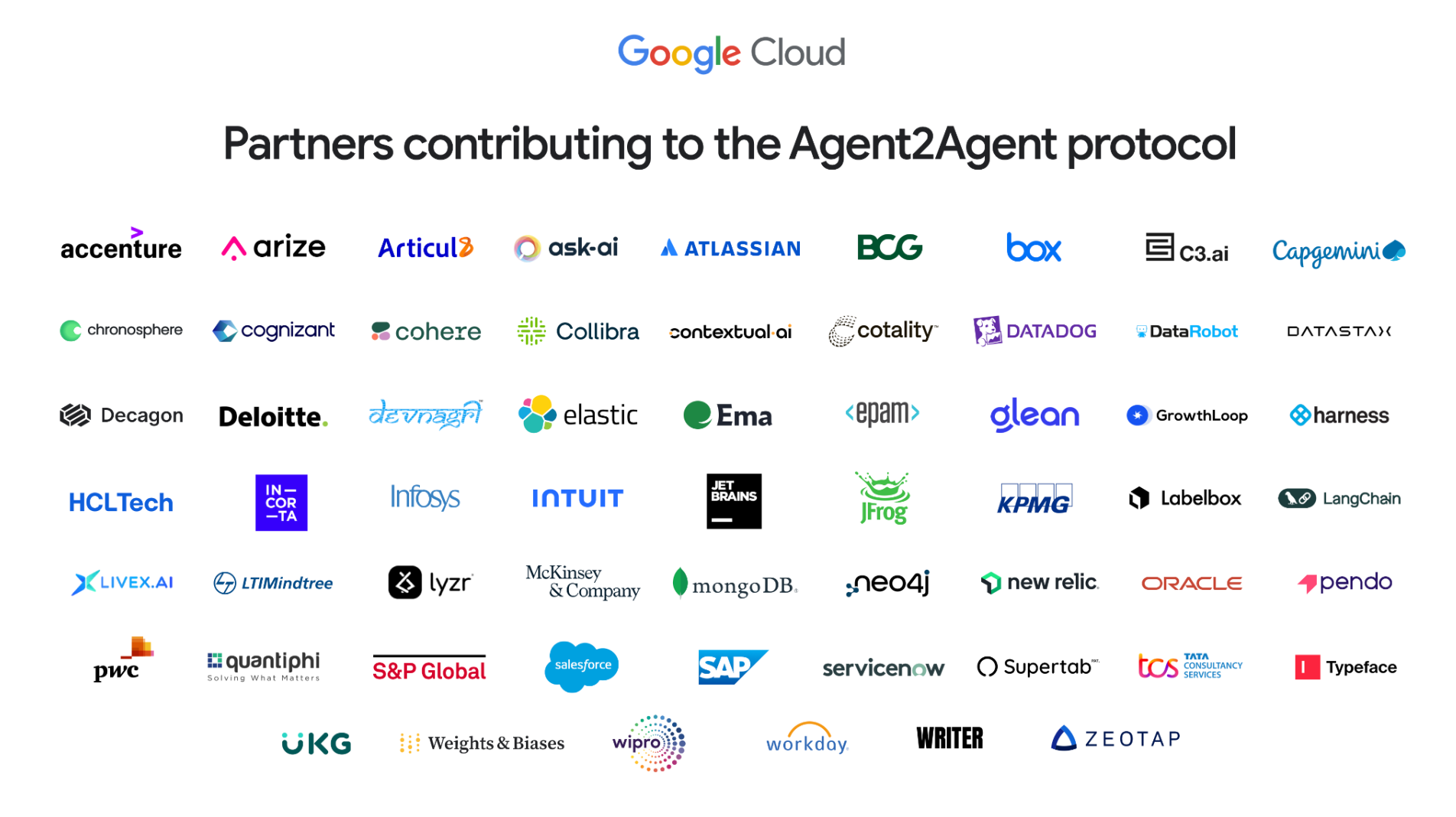
Open source communities continue to provide vital collaborative spaces to define emerging standards, ensuring the interoperability and extensibility for the next generation of technologies. In 2025, we worked with more than 50 partners on the Agent2Agent (A2A) protocol to enable AI agents to communicate with each other, securely exchange information, and coordinate actions on top of various enterprise platforms and applications. Within weeks of our initial announcement, Google donated the A2A project to the Linux Foundation as part of our long-standing commitment to develop "open, collaborative ecosystem – offering greater autonomy and multiplying productivity."

Google Cloud - Partners contributing to the Agent 2 Agent protocol - Accenture, Arize, Articul, ask-ai, Atlassian, BCG, Box, c3.ai, Capgemini, Chronosphere, Cognizant, Cohere, Colibra, Contextual.ai, Cotality, Datadog, and more

Launching tools with transparency

Open source licenses provide a framework for anyone to explore, test, fork and expand on our technologies. Over the last 15 years, Google has created more than 15,000 public repositories on GitHub. Today, Google continues to maintain more than 5,000 public repositories on GitHub, and more than 1,500 public repositories on Git-on-Borg. A quick look back to some highlights from our 2025 launches includes:

  • Gemma 3 – a collection of lightweight open models built from the same research and technology that powers our Gemini 2.0 models. They are designed to run directly on devices — from phones and laptops to workstations — helping developers create AI applications, wherever people need them. Since Gemma’s release in 2024, the Gemmaverse community has created more than 60,000 Gemma variants. We’ve continued work on this collection and in 2026 we released Gemma 4 under an Apache 2.0 license.
  • Agent Development Kit – an open-source framework and SDK designed to help developers build, compose, and run both conversational and non-conversational AI agents.

Adjusting our collective security practices

As the threat landscape evolves and accelerates in the AI era, we are working on novel solutions to mitigate vulnerabilities at scale and remove some of the burden from overloaded maintainers. In 2025, we introduced several critical security initiatives to support upstream open source projects:

  • CodeMender: An agent designed to be both reactive, instantly patching new vulnerabilities, and proactive, rewriting and securing existing code and eliminating entire classes of vulnerabilities in the process. In its first six months, we were able to upstream 72 security fixes to open source projects, including some as large as 4.5 million lines of code.
  • OSS Rebuild: A security initiative to prevent software supply chain attacks by verifying build provenance. It automates package rebuilding and semantically compares results to upstream artifacts to detect tampered code on registries like PyPI, npm, and Crates.io.
  • OSV-Scalibr: (Software Composition Analysis Library) the core engine for vulnerability scanning used internally and in OSV-Scanner.
  • Credential Scanning on deps.dev: A service (using Veles) that actively scans open-source packages on deps.dev for leaked GCP credentials to prevent account compromise.

Working together to sustain the contributor community

Beyond security contributions, we remain committed to providing financial support directly to projects and maintainers. In 2025, the Open Source Programs Office (OSPO) directed $2M in sponsorships and investments to more than 40 open source projects.

Google Summer of Code celebrated its 21st year of enabling open source organizations to find, mentor, and onboard new contributors, directly supporting 1,280 individuals to contribute to 185 organizations. Over its lifetime, the global program has connected more than 23,000 participants from 125 countries with over 1,000 open source organizations globally. Moving forward, we recognize the need to evolve our program structures to ensure they continue to effectively support maintainers in the AI era.

Evolving the way we work in open spaces

Respecting community norms and practices is fundamental to establishing and maintaining trust in open source communities. To ensure we remain supportive members of your community, we encourage projects to document preferred practices and policies in the wake of new technologies. As AI changes the way we work, we are continually evaluating how best to evolve the way we engage in open spaces to preserve, prepare and bolster the communities we depend on.

We are deeply grateful for the many individuals and organizations that have worked with us to create global technologies from which everyone can benefit. You can continue to learn more about our open source initiatives, ongoing programs, and new projects at opensource.google.

Appendix: About this data

This report features metrics provided by many teams and programs across Alphabet. In regards to the code and code-adjacent activities data, we wanted to share more details about the derivation of those metrics.

  • Data sources: These data represent the activities of Alphabet employees on public repositories hosted on GitHub and our internal production Git service Git-on-Borg. These sources represent a subset of open source activity currently tracked by Google OSPO.
  • Business and personal: Activity on GitHub reflects a mixture of Alphabet projects, third-party projects, experimental efforts, and personal projects. Our metrics report on all of the above unless otherwise specified.
  • Alphabet contributors: Please note that unless additional detail is specified, activity counts attributed to Alphabet open source contributors will include our full-time employees as well as our extended Alphabet community (temps, vendors, contractors, and interns). In 2025, full time employees at Alphabet represented more than 95% of our open source contributors.
  • GitHub Accounts: For counts of GitHub accounts not affiliated with Alphabet, we cannot assume that one account is equivalent to one person, as multiple accounts could be tied to one individual or bot account.
  • Active counts: Where possible, we will show ‘active users’ defined by logged activity (excluding ‘WatchEvent’) within a specified timeframe (a month, year, etc.) and ‘active repositories’ and ‘active projects’ as those that have enough activity to meet our internal active-project criteria and have not been archived.
.