opensource.google.com

Menu

Wrapping Our Fifth Google Summer of Code

Wednesday, August 26, 2009


The sun has set on our fifth year of introducing college and university students to Free and Open Source software development, and what a year it's been! Just under 2000 mentors and 1000 students began working together to improve the code bases of 150 projects, and we're pleased to let folks know that 85 percent of our student participants have received passing final evaluations, up a full two percent over 2008 and our best success rate to date.

These successful Open Sourcerers are busy preparing code samples for the world's perusal, and we'll post an update here when actual source code produced during this year's Google Summer of Code has been made available on project hosting on Google Code. Of course, there's no real need to wait for code samples - many of these students have already had their work integrated into their project's code base, so check out their work by visiting the websites and mailing lists of your favorite participating projects now. We'll also be publishing more extensive statistics from our program evaluations, along with wrap up reports from some of our participating mentoring organizations, so stay tuned for more details in the coming weeks.
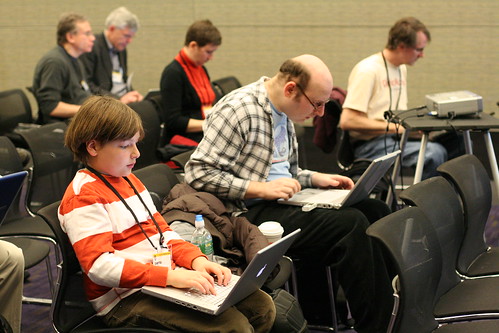

Google Summer of Code Mentors Dimitri Gaskin and Karoly Negyesi
Photo courtesy of Scott Hadfield

Congratulations to all of our students for their achievements this Summer. We certainly hope you will continue helping your project communities with source code, documentation and general enthusiasm long after this Summer has ended. Many thanks also to our community of mentors, without whose time, skill and dedication this program would not be possible.

DebConf9 in Cáceres, Spain: Time of changes

Tuesday, August 25, 2009


Every year several hundreds of Debian contributors from around the world get together at DebConf in a different city to share a week (or more!) of work, friendship and fun.

The 10th annual Debian Developers Conference just ended a few days ago in the beautiful medieval city of Cáceres in Spain with Debian Project Leader Steve McIntyre concluding: "This has been one of the most productive conferences we have ever held. Our developers and teams achieved a great deal during this short period, and this will surely have a big impact on the upcoming release of 'Squeeze'."

Among the many notable talks were the release goals and plans for Debian GNU/Linux 6.0 "Squeeze" as well as the new timed freezes release policy, and the Project Leader's keynote about working further towards Debian's motto of being the "universal operating system".

In all, over 130 different sessions took place during the conference, ranging from formal talks to numerous spontaneously scheduled meetings. For most of these sessions, live video streams were made available over the internet as well as recordings: http://debconf9.debconf.org/video.

Also this year, several students from the Google Summer of Code program in the Debian project were present to receive feedback on their projects, gather new ideas, and establish relationships with fellow developers. Along with the technical discussions and idea exchange, the students were able to experience by themselves the Debian community, one of the key factors that makes Debian the amazing project that it is.


Google Summer of Code™ students and Debian Developrs, left to right: Sha Liu, Per Andersson, Diego Escalante, Michael Schultheiss, Obey Arthur Liu, Bdale Garbee, Neil McGovern, Steve McIntyre (Debian Project Leader)

Attending as Google Summer of Code students were: Per Andersson, Diego Escalante and Sha Liu. Aurelien Jarno and Wookey were present as mentors and, Obey Arthur Liu and Steve McIntyre as administrators. Sadly this year we couldn't have the full Google Summer of Code crew due to problems with visas, work, universities.. but the very high concentration of Debian Developers has helped several Google Summer of Code projects both on site and remotely.

As the week progressed students were able to get feedback from different people about their current work:

Per Andersson, flying from Stockholm, Sweden: working on adding support for installing Debian on MTD flash based devices, opening Debian to a whole new class of popular embedded devices.
"DebConf9 really met my expectations. Loads of freedom loving nerds -- People like me! During the week I had the chance to engage people whom worked with related software; amongst them Debian Installer and GNU Parted developers. I also made contact with the Debian FreeSmartphone.org team, who maintains packages targeted at OpenMoko phones."

Diego Escalante, flying from Lima, Perú: working on Amancay, a new interface to the Debian Bug Tracking System targeted at improved collaboration.
"I was able to talk with others about ideas and important points to consider to get more people involved in triaging bugs in Debian. Also users and developers shared thought-some feelings about increasing triaging and how it would affect them. Above all, the conference also gave me the chance to get an inside look of how Debian developers work and think and how they are different from other developer communities I know, allowing me to take more things into account in designing the UI of."

Sha Liu, flying from Shanghai, China: working on creating a mips3 port, bringing to an important range of netbooks popular in Asia.
"I discussed problems I encountered in the project and introduced the loongson2F CPU to many developers interested in porting their software to mips. The members of the emdebian team shared with me a lot of valuable experience including using the qemu simulator, the process of building a Debian armel port etc. However, the most important things I learned during DebConf9 was the infrastructure and philosophy of Debian-the most universal operating system."


All the attendees going to the daytrip to Valle del Jerte: hiking, swimming, sunbathing.

The whole Debian community is grateful to Google for being a great sponsor of the conference and specifically sponsoring the entire travel costs of our Google Summer of Code students.

The Google Summer of Code has been a success for each of the past four years Debian has participated, and we look forward to welcoming more students at Debian and DebConf.

See you in 2010 at DebConf10, taking place this time in the heart of Manhattan, New York City, USA!

Photos courtesy of Aigars Mahinovs

Food and Fun: Linux 18th Anniversary Picnic

Friday, August 21, 2009

The annual Linux 18th Anniversary Picnic happened last weekend at Sunnyvale Baylands Park in Sunnyvale, CA. It happens around the weekend following the Linux World Expo (now Open Source World) and generally in the same time frame as the anniversary of the announcement of Linux. Sbay.org, a local non-profit, organizes this social event to get the Free and Open Source community together for a day of fun, and some form of the picnic has happened every year since 2001.


This year was great fun. I was responsible for buying the food for the picnic. In true Google fashion, there was a ton of food. After a few trips to supermarkets, we had more hamburgers, hot dogs, veggieburgers, sodas, and condiments than I had ever assembled for one event. Of course, we also had wifi for those working on their personal projects, provided by a portable point-to-point wireless link that was set up by some of the attendees.

Throughout the day, more than 250 people showed up to the picnic. Some brought their geeky gadgets to work on, some hacked on their Open Source projects. Others spent time getting some much needed socializing. When I wasn't making runs for more food or other supplies, I got to talk to some of the people about how they used Linux. A number of the people used it on their daily jobs as system administrators or software engineers. Some were there with friends to learn about Linux for the first time. I even demoed my laptop setup for some folks that were curious about the difference between what they were using and Linux.


All in all, the day went really well and helped draw out members of the Free and Open Source software community out under that weird ball of fire in the sky, and everyone had fun. We'd like to thank Google's Open Source Team and our other sponsors for making sure we all had plenty to nosh on whilst enjoying each others company. 

If you would like to get involved in the future, please see  http://www.linuxpicnic.org/ and http://www.sbay.org/. We can always use additional help and would love to see you next year!

Photos courtesy of Jennifer Davis.

Zurich Open Source Jam 8

Thursday, August 20, 2009

On August 13th, 2009, starting at 6 PM a little more than 50 people trickled into our Zurich, Switzerland office to share thoughts and snacks about all things free as in freedom for the 8th edition of the Zurich Open Source Jam. By 7 PM, a great variety of talks were lined up on the whiteboard and we started with our traditional lightning talks.


Markus Michael Geipel introduced us to his research on Dynamics of Open Source Code, providing quantitative insights into laws of growths, change dynamics and special structures applicable to open source development. He also presented us with a research tool developed for this project and contributed to Open Source, a workbench for relations visualization.


Lukas Lang, a Google Summer of Code™ 2008 student, talked about a program at the Institute for Software Technology of Vienna University of Technology to involve students in Open Source during a semester as a subject. Students participate into Open Source organizations such as Apache Software Foundation and develop independent proposals to achieve during the semester, not unlike the Google Summer of Code.


Matthaus Ringwald presented BTstack, a lightweight and portable Bluetooth stack for embedded machines. BTstack targets devices such as the iPhone, where the existing Bluetooth stack is severely limited, or embedded operating systems lacking any Bluetooth support. He presented us with a live demonstration of a WiiMote controlling over Bluetooth a 3D object in an OpenGL ES application running on an iPhone.


Michel Pauli recounted to us his travels in Africa and in particular his work in a school in Limbe, Cameroon. He has been using Open Source software to run a computer lab using partly scavenged hardware with great success. With tools such as LTSP,Xen, Edubuntu or Moodle, he used computers to transmit a broad range of knowledge on only a few watts of electricity.


David Anderson presented NxOS, an operating system base for the Lego Mindstorms NXT robotics kit. The system aims to simplify the basic job of other NXT operating systems such as Lejos, as well as open the doors for new experiments with the kit. The topic of killer robot armies made of lego, foremost in everyone's minds, was of course discussed.


Tara Andrews told us how Open Source would help the Humanities. She explained how the current state of specialty humanities software impedes collaboration and research, and envisaged what computing in the Humanities could achieve if open source software development methodologies were being efficiently used. We traveled all over Europe through her fascinating stories of copist monks, manuscripts collecting, Unicode mangling and massive textual corpus diffing.

The rest of the evening saw Googlers and guests happily chatting about all kinds of subjects and 10 PM was too soon and the (Swiss) beer still unfinished when we had to mark the end of this edition of the Zurich Open Source Jam.

To stay informed about future Open Source Jams in Zurich, please join the Open Source Jam Zurich Google Group. Open Source Jams are sponsored by the Google Open Source Team.

Scientists Camp Out* At Google

Wednesday, August 19, 2009

Last month, around 250 invited scientists and science-related journalists, artists, and educators flocked to Google for the fourth annual Science Foo Camp (SciFoo). SciFoo is an unconference jointly presented by Google, O'Reilly Media, and Nature Publishing.

In true Google tradition, the conference began with dinner, followed by an orientation session led by conference hosts Tim O'Reilly, Sara Winge, Chris DiBona, and Timo Hannay. Immediately after, the schedule for the weekend was created by attendees covering large boards with giant post-it notes of topics.


Tim O'Reilly, Sara Winge, Chris DiBona and Timo Hannay open the conference
(Photo Credit: Suhky Dhaliwal and Ellen Ko)


Filling in the schedule boards
(Photo Credit: Bertalan Meskó)

Attendees came from all branches of science and technology, and included luminaries such as Marvin Minksy, Louise Leakey, Peter Diamandis, Bill Nye, and George Smoot. But the conference isn't only for the famous. There were many physicists, biologists, psychiatrists, chemists, and almost every other -ist represented. Experimental poet Christian Bok and puzzle maker Pavel Curtis provided interesting views on many topics.

The sessions were as varied as the attendees. Things discussed included artificial intelligence, the challenges of science education, cartoon physics, space travel, climate change, swine flu, data sharing, microbes, and more. That list doesn't even begin to scratch the surface, or include conversations had when a rocket scientist and a computational biologist sit down at the same table for lunch.


Jam session at the campground
(Photo Credit: Suhky Dhaliwal and Ellen Ko)

The event wasn't all discussion, Google demo'ed a street view tricycle and a holodeck -- tools for collecting and displaying geodata. The holodeck even provided an opportunity to visit all of Earth and Mars.


Google Earth as seen in the holodeck
(Photo Credit: Suhky Dhaliwal and Ellen Ko)

You couldn't put this many scientists in one place without doing some real science. Dr. Larry Weiss brought supplies for performing MRSA screening. Googler volunteers discovered that you could get almost anyone to stick a giant q-tip up their nose in the name of science. Lapsed Googler Simon Quellen Field and Theodore Gray, co-founder of Wolfram Research, created ice cream with only milk, sugar, liquid nitrogen, and power tools.


Simon Quellen Field and Theodore Gray make liquid nitrogen ice cream


Baris Baser, SciFoo volunteer, describes SciFoo as "hands down one of my favorite events at Google. I really enjoy how it brings volunteers together from different offices and departments. The spontaneity makes it unpredictable and unique."

For more information on what went on at SciFoo '09 visit Nature's aggregator or Google Blog Search.

*and no, there was no actual camping at SciFoo Camp ;)

.