opensource.google.com

Menu
Showing posts with label research. Show all posts

Showing Our Work: A Study In Understanding Open Source Contributors

Thursday, September 7, 2023

In 2022, the research team within Google’s Open Source Programs Office launched an in-depth study to better understand open source developers, contributors, and maintainers. Since Alphabet is a large consumer of and contributor to open source, our primary goals were to investigate the evolving needs and motivations of open source contributors, and to learn how we can best support the communities we depend on. We also wanted to share our findings with the community in order to further research efforts and our collective understanding of open source work.

Key findings from this work suggest that community leaders should:

  • Value your time together and apart: Lack of time was cited as the leading reason ‘not to contribute’ as well as motivation to ‘leave a community’. This should encourage community leaders to adopt practices that ensure that they are making the most of the time they have together. One example: some projects have planned breaks, no-meeting weeks, or official slowdowns during holidays or popular conference weeks.
  • Invest in documentation: Contributors and maintainers expressed that task variety, delegation, and onboarding new maintainers could help to reduce burnout in open source. Documentation is one way to make individual knowledge accessible to the community. In addition to technical and procedural overviews, documentation can also be used to clarify roles, tasks, expectations, and a path to leadership.
  • Always communicate with care: Contributors prefer projects that have welcoming communities, clear onboarding paths, and a code of conduct. Communication is the primary way for community leaders to promote welcoming and inclusive communities and set norms around language and behavior (as documented in a Code of Conduct). Communication is also how we build relationships, trust, and respect for each other.

  • Create spaces for anonymous feedback: Variable answers between demographic subsets in our research suggest that while systematic approaches can be taken to reduce burnout, there is no one-size-fits-all approach. Feedback is a valuable tool for any project to adjust to the evolving needs of their contributor and user communities. When designed appropriately, surveys can serve as safe, anonymous, retaliation-free spaces for individuals to provide honest feedback.

How do contributors select projects?
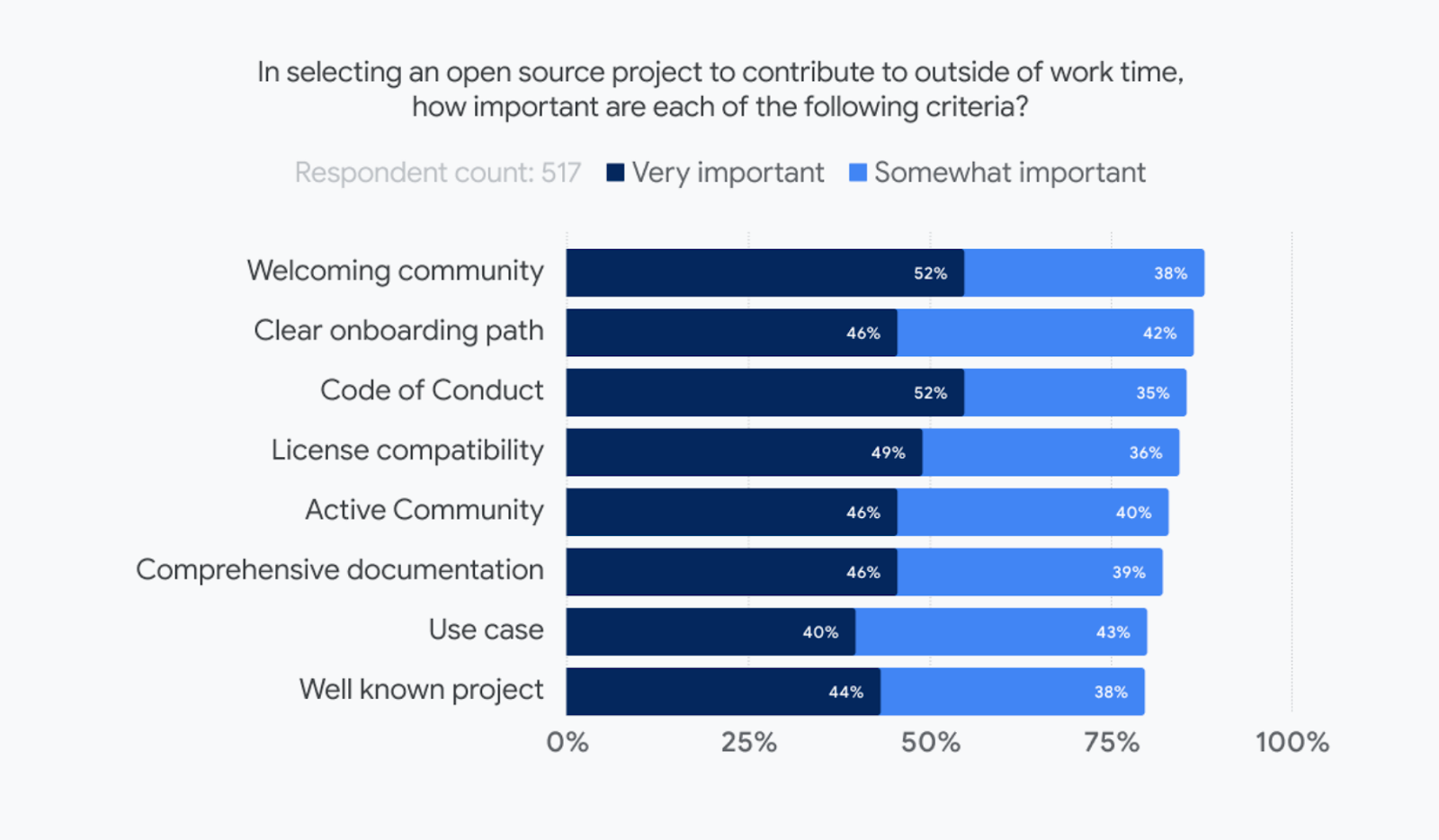
We asked respondents to share their most important criteria when selecting an open source project to contribute to in their personal time. The top responses were: welcoming community, clear onboarding path, and code of conduct.
Base: 517 international OSS developers, contributors, maintainers and students who worked on open source in their personal time

Within Google’s Open Source Programs office, we are constantly looking for ways to improve support for contributors inside and outside of Google. Studies such as this one provide guidance to our programs and investments in the community. This work helps us to see we should continue to:

  • Invest in documentation competency: Google Season of Docs provides support for open source projects to improve their documentation and gives professional technical writers an opportunity to gain experience in open source.
  • Document roles and promote tactics that recognize work within communities: The ACROSS project continues to work with projects and communities to establish consistent language to define roles, responsibilities, and work done within open source projects.
  • Exercise and discuss ‘better’ practices within the community: While we continually seek to improve our engagement practices within communities, we will also continue to share these experiences with the broader community in hopes that we can all learn from our successes and challenges. For example, we’ve published documentation around our release process, including resources for the creation and management of a code of conduct.

This research, along with other articles authored by the OSPO research team is now available on our site.

By Sophia Vargas – Researcher, Google Open Source Programs Office

Video Architecture Search

Monday, October 21, 2019

Video understanding is a challenging problem. Because a video contains spatio-temporal data, its feature representation is required to abstract both appearance and motion information. This is not only essential for automated understanding of the semantic content of videos, such as web-video classification or sport activity recognition, but is also crucial for robot perception and learning. Just like humans, an input from a robot’s camera is seldom a static snapshot of the world, but takes the form of a continuous video.

The abilities of today’s deep learning models are greatly dependent on their neural architectures. Convolutional neural networks (CNNs) for videos are normally built by manually extending known 2D architectures such as Inception and ResNet to 3D or by carefully designing two-stream CNN architectures that fuse together both appearance and motion information. However, designing an optimal video architecture to best take advantage of spatio-temporal information in videos still remains an open problem. Although neural architecture search (e.g., Zoph et al, Real et al) to discover good architectures has been widely explored for images, machine-optimized neural architectures for videos have not yet been developed. Video CNNs are typically computation- and memory-intensive, and designing an approach to efficiently search for them while capturing their unique properties has been difficult.

In response to these challenges, we have conducted a series of studies into automatic searches for more optimal network architectures for video understanding. We showcase three different neural architecture evolution algorithms: learning layers and their module configuration (EvaNet); learning multi-stream connectivity (AssembleNet); and building computationally efficient and compact networks (TinyVideoNet). The video architectures we developed outperform existing hand-made models on multiple public datasets by a significant margin, and demonstrate a 10x~100x improvement in network runtime.

EvaNet: The First Evolved Video Architectures

EvaNet, which we introduce in “Evolving Space-Time Neural Architectures for Videos” at ICCV 2019, is the very first attempt to design neural architecture search for video architectures. EvaNet is a module-level architecture search that focuses on finding types of spatio-temporal convolutional layers as well as their optimal sequential or parallel configurations. An evolutionary algorithm with mutation operators is used for the search, iteratively updating a population of architectures. This allows for parallel and more efficient exploration of the search space, which is necessary for video architecture search to consider diverse spatio-temporal layers and their combinations. EvaNet evolves multiple modules (at different locations within the network) to generate different architectures.

Our experimental results confirm the benefits of such video CNN architectures obtained by evolving heterogeneous modules. The approach often finds that non-trivial modules composed of multiple parallel layers are most effective as they are faster and exhibit superior performance to hand-designed modules. Another interesting aspect is that we obtain a number of similarly well-performing, but diverse architectures as a result of the evolution, without extra computation. Forming an ensemble with them further improves performance. Due to their parallel nature, even an ensemble of models is computationally more efficient than the other standard video networks, such as (2+1)D ResNet. We have open sourced the code.


Examples of various EvaNet architectures. Each colored box (large or small) represents a layer with the color of the box indicating its type: 3D conv. (blue), (2+1)D conv. (orange), iTGM (green), max pooling (grey), averaging (purple), and 1x1 conv. (pink). Layers are often grouped to form modules (large boxes). Digits within each box indicate the filter size.

AssembleNet: Building Stronger and Better (Multi-stream) models

In “AssembleNet: Searching for Multi-Stream Neural Connectivity in Video Architectures”, we look into a new method of fusing different sub-networks with different input modalities (e.g., RGB and optical flow) and temporal resolutions. AssembleNet is a “family” of learnable architectures that provide a generic approach to learn the “connectivity” among feature representations across input modalities, while being optimized for the target task. We introduce a general formulation that allows representation of various forms of multi-stream CNNs as directed graphs, coupled with an efficient evolutionary algorithm to explore the high-level network connectivity. The objective is to learn better feature representations across appearance and motion visual clues in videos. Unlike previous hand-designed two-stream models that use late fusion or fixed intermediate fusion, AssembleNet evolves a population of overly-connected, multi-stream, multi-resolution architectures while guiding their mutations by connection weight learning. We are looking at four-stream architectures with various intermediate connections for the first time — 2 streams per RGB and optical flow, each one at different temporal resolutions.

The figure below shows an example of an AssembleNet architecture, found by evolving a pool of random initial multi-stream architectures over 50~150 rounds. We tested AssembleNet on two very popular video recognition datasets: Charades and Moments-in-Time (MiT). Its performance on MiT is the first above 34%. The performances on Charades is even more impressive at 58.6% mean Average Precision (mAP), whereas previous best known results are 42.5 and 45.2.


The representative AssembleNet model evolved using the Moments-in-Time dataset. A node corresponds to a block of spatio-temporal convolutional layers, and each edge specifies their connectivity. Darker edges mean stronger connections. AssembleNet is a family of learnable multi-stream architectures, optimized for the target task.


A figure comparing AssembleNet with state-of-the-art, hand-designed models on Charades (left) and Moments-in-Time (right) datasets. AssembleNet-50 or AssembleNet-101 has an equivalent number of parameters to a two-stream ResNet-50 or ResNet-101.

Tiny Video Networks: The fastest video understanding networks

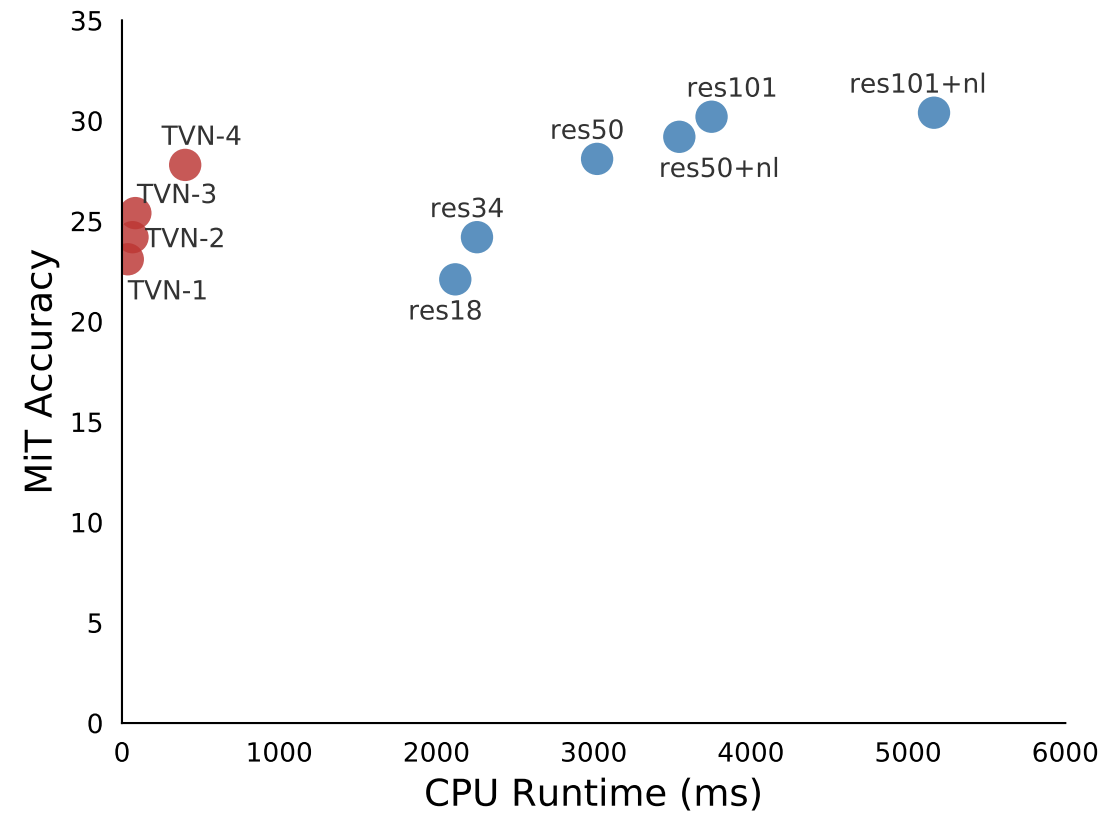
In order for a video CNN model to be useful for devices operating in a real-world environment, such as that needed by robots, real-time, efficient computation is necessary. However, achieving state-of-the-art results on video recognition tasks currently requires extremely large networks, often with tens to hundreds of convolutional layers, that are applied to many input frames. As a result, these networks often suffer from very slow runtimes, requiring at least 500+ ms per 1-second video snippet on a contemporary GPU and 2000+ ms on a CPU. In Tiny Video Networks, we address this by automatically designing networks that provide comparable performance at a fraction of the computational cost. Our Tiny Video Networks (TinyVideoNets) achieve competitive accuracy and run efficiently, at real-time or better speeds, within 37 to 100 ms on a CPU and 10 ms on a GPU per ~1 second video clip, achieving hundreds of times faster speeds than the other human-designed contemporary models.

These performance gains are achieved by explicitly considering the model run-time during the architecture evolution and forcing the algorithm to explore the search space while including spatial or temporal resolution and channel size to reduce computations. The below figure illustrates two simple, but very effective architectures, found by TinyVideoNet. Interestingly the learned model architectures have fewer convolutional layers than typical video architectures: Tiny Video Networks prefers lightweight elements, such as 2D pooling, gating layers, and squeeze-and-excitation layers. Further, TinyVideoNet is able to jointly optimize parameters and runtime to provide efficient networks that can be used by future network exploration.


TinyVideoNet (TVN) architectures evolved to maximize the recognition performance while keeping its computation time within the desired limit. For instance, TVN-1 (top) runs at 37 ms on a CPU and 10ms on a GPU. TVN-2 (bottom) runs at 65ms on a CPU and 13ms on a GPU.


CPU runtime of TinyVideoNet models compared to prior models (left) and runtime vs. model accuracy of TinyVideoNets compared to (2+1)D ResNet models (right). Note that TinyVideoNets take a part of this time-accuracy space where no other models exist, i.e., extremely fast but still accurate.

Conclusion

To our knowledge, this is the very first work on neural architecture search for video understanding. The video architectures we generate with our new evolutionary algorithms outperform the best known hand-designed CNN architectures on public datasets, by a significant margin. We also show that learning computationally efficient video models, TinyVideoNets, is possible with architecture evolution. This research opens new directions and demonstrates the promise of machine-evolved CNNs for video understanding.

Acknowledgements

This research was conducted by Michael S. Ryoo, AJ Piergiovanni, and Anelia Angelova. Alex Toshev and Mingxing Tan also contributed to this work. We thank Vincent Vanhoucke, Juhana Kangaspunta, Esteban Real, Ping Yu, Sarah Sirajuddin, and the Robotics at Google team for discussion and support.

Dopamine 2.0: providing more flexibility in reinforcement learning research

Wednesday, February 6, 2019

Reinforcement learning (RL) has become one of the most popular fields of machine learning, and has seen a number of great advances over the last few years. As a result, there is a growing need from both researchers and educators to have access to a clear and reliable framework for RL research and education.

Last August, we announced Dopamine, our framework for flexible reinforcement learning.  For the initial version we decided to focus on a specific type of RL research: value-based agents evaluated on the Atari 2600 framework supported by the Arcade Learning Environment. We were thrilled to see how well it was received by the community, including a live coding session, its inclusion in a recently-announced benchmark for RL, considered as the top “Cool new open source project of 2018” by the Octoverse, and over 7K GitHub stars on our repository.

One of the most common requests we have received is support for more environments. This confirms what we have seen internally, where simpler environments, such as those supported by OpenAI’s Gym, are incredibly useful when testing out new algorithms. We are happy to announce Dopamine 2.0, which includes support for discrete-domain gym environments (e.g. discrete states and actions). The core of the framework remains unchanged, we have simply generalized the interface with the environment. For backwards compatibility, users will still be able to download version 1.0.

We include default configurations for two classic control environments: CartPole and Acrobot; on these environments one can train a Dopamine agent in minutes. When compared with the training time for a standard Atari 2600 game (around 5 days on a standard GPU), these environments allow researchers to iterate much faster on research ideas before testing them out on larger Atari games. We also include a Colaboratory that illustrates how to train an agent on Cartpole and Acrobot. Finally, our GymPreprocessing class serves as an example for how to use Dopamine with other custom environments.

We are excited by the new opportunities enabled by Dopamine 2.0, and look forward to seeing what the research community creates with it!

By Pablo Samuel Castro and Marc G. Bellemare, Dopamine Team

Tangent: Source-to-Source Debuggable Derivatives

Wednesday, November 8, 2017

Crossposted on the Google Research Blog

Tangent is a new, free, and open source Python library for automatic differentiation. In contrast to existing machine learning libraries, Tangent is a source-to-source system, consuming a Python function f and emitting a new Python function that computes the gradient of f. This allows much better user visibility into gradient computations, as well as easy user-level editing and debugging of gradients. Tangent comes with many more features for debugging and designing machine learning models.
This post gives an overview of the Tangent API. It covers how to use Tangent to generate gradient code in Python that is easy to interpret, debug and modify.

Neural networks (NNs) have led to great advances in machine learning models for images, video, audio, and text. The fundamental abstraction that lets us train NNs to perform well at these tasks is a 30-year-old idea called reverse-mode automatic differentiation (also known as backpropagation), which comprises two passes through the NN. First, we run a “forward pass” to calculate the output value of each node. Then we run a “backward pass” to calculate a series of derivatives to determine how to update the weights to increase the model’s accuracy.

Training NNs, and doing research on novel architectures, requires us to compute these derivatives correctly, efficiently, and easily. We also need to be able to debug these derivatives when our model isn’t training well, or when we’re trying to build something new that we do not yet understand. Automatic differentiation, or just “autodiff,” is a technique to calculate the derivatives of computer programs that denote some mathematical function, and nearly every machine learning library implements it.

Existing libraries implement automatic differentiation by tracing a program’s execution (at runtime, like TF Eager, PyTorch and Autograd) or by building a dynamic data-flow graph and then differentiating the graph (ahead-of-time, like TensorFlow). In contrast, Tangent performs ahead-of-time autodiff on the Python source code itself, and produces Python source code as its output.
As a result, you can finally read your automatic derivative code just like the rest of your program. Tangent is useful to researchers and students who not only want to write their models in Python, but also read and debug automatically-generated derivative code without sacrificing speed and flexibility.

You can easily inspect and debug your models written in Tangent, without special tools or indirection. Tangent works on a large and growing subset of Python, provides extra autodiff features other Python ML libraries don’t have, is high-performance, and is compatible with TensorFlow and NumPy.

Automatic differentiation of Python code

How do we automatically generate derivatives of plain Python code? Math functions like tf.exp or tf.log have derivatives, which we can compose to build the backward pass. Similarly, pieces of syntax, such as  subroutines, conditionals, and loops, also have backward-pass versions. Tangent contains recipes for generating derivative code for each piece of Python syntax, along with many NumPy and TensorFlow function calls.

Tangent has a one-function API:
import tangent
df = tangent.grad(f)
Here’s an animated graphic of what happens when we call tangent.grad on a Python function:
If you want to print out your derivatives, you can run
import tangent
df = tangent.grad(f, verbose=1)
Under the hood, tangent.grad first grabs the source code of the Python function you pass it. Tangent has a large library of recipes for the derivatives of Python syntax, as well as TensorFlow Eager functions. The function tangent.grad then walks your code in reverse order, looks up the matching backward-pass recipe, and adds it to the end of the derivative function. This reverse-order processing gives the technique its name: reverse-mode automatic differentiation.

The function df above only works for scalar (non-array) inputs. Tangent also supports
Although we started with TensorFlow Eager support, Tangent isn’t tied to one numeric library or another—we would gladly welcome pull requests adding PyTorch or MXNet derivative recipes.

Next Steps

Tangent is open source now at github.com/google/tangent. Go check it out for download and installation instructions. Tangent is still an experiment, so expect some bugs. If you report them to us on GitHub, we will do our best to fix them quickly.

We are working to add support in Tangent for more aspects of the Python language (e.g., closures, inline function definitions, classes, more NumPy and TensorFlow functions). We also hope to add more advanced automatic differentiation and compiler functionality in the future, such as automatic trade-off between memory and compute (Griewank and Walther 2000; Gruslys et al., 2016), more aggressive optimizations, and lambda lifting.

We intend to develop Tangent together as a community. We welcome pull requests with fixes and features. Happy deriving!

By Alex Wiltschko, Research Scientist, Google Brain Team

Acknowledgments

Bart van Merriënboer contributed immensely to all aspects of Tangent during his internship, and Dan Moldovan led TF Eager integration, infrastructure and benchmarking. Also, thanks to the Google Brain team for their support of this post and special thanks to Sanders Kleinfeld and Aleks Haecky for their valuable contribution for the technical aspects of the post.

Google Summer of Code 2016 wrap-up: CSE@TU Wien

Wednesday, December 14, 2016

Every year over a thousand university students work with more than a hundred open source organizations as part of the Google Summer of Code (GSoC). This post is part of a series of guest posts from students, mentors and organization administrators reflecting on GSoC 2016.

CSE@TU Wien is a loose interest group at the Technische Universität Wien (TU Wien) focused on developing, providing and utilizing free and open source software for research. We’re an umbrella organization for several open source projects and we participate in Google Summer of Code (GSoC) to ensure that future generations continue building open source software for scientific computing.

We’ve participated in GSoC most years since 2011, and in 2016 we had ten successful projects. The thematic areas are -- befitting an engineering-focused university -- very diverse. Let’s take a look at the projects and what students accomplished:

Carbon Footprint for Google Maps is a browser extension that calculates CO2 emissions that users would incur by driving on routes suggested by popular mapping services and displays this information alongside time and distance. The aim is to raise awareness of the environmental impact of driving cars.

Kolya Opahle brilliantly re-factored the extension, making it much more modular. This enabled expansion to include other map services and port to other browsers, with browser-specific implementations reduced to a minimum. Building for specific browsers was made easy through a Gradle build script. He took on the Firefox port himself, which turned out to be more challenging than expected due to incompatibilities between the extension API’s of Firefox and Chrome. Overcoming this challenge required ingenuity. 

Prateek Gupta completely re-designed and reimplemented the extension’s user interface, optimizing the storage of user options and allowing localization. He added support for more mapping services and calculations of additional greenhouse gases. He added new features to give the user more information about greenhouse gas emissions, including: 
  • a page with air quality index using an API from the World Air Quality Index
  • a page with tips to reduce emissions; a calculator to compute CO2 absorption by trees
  • another calculator for the benefits of walking and cycling instead of driving
Chirag Arora ported the extension to the Safari web browser. Like the port to Firefox, this proved challenging due to discrepancies between the Chrome and Safari extension API’s. Chirag also implemented several new features, including: 
  • more unit systems in the options page
  • automatic configuration of fuel price based on location and the Global Petrol Prices API
  • approximate calculation of CO2 emissions for public transportation
The Colibri project focuses on smart building energy management. Intelligent control strategies are becoming more and more important for efficiently operating residential and commercial buildings, as buildings are responsible for a significant amount of global energy consumption.

Georg Faustmann implemented a connector for Open Automated Demand Response (OpenADR) networks. OpenADR information and signals can now be processed and stored in the Colibri data store. One challenge for this student was comprehensive handling of the OpenADR specification. Based on the specification, Georg identified a set of relevant use cases which were finally realized in this Colibri component.

Josef Wechselauer worked on a connector for gateways based on the OASIS Open Building Information Exchange (OBIX) standard. This connector links physical devices and data from building automation systems to Colibri. Josef was very enthusiastic and he implemented the connector with an additional graphical user interface for browsing through available OBIX objects. The system test with real hardware was challenging, but he solved all of the problems.

Pratyush Talreja implemented a connector that enables the integration of MATLAB Simulink simulations. More precisely, the connector links to the MATLAB environment and can read and write data over interfaces provided by the simulation. Pratyush had some initial troubles with the system design and the role of the connector in the overall system. However, he tackled those challenges and succeeded in the end.

Mind the Word is a browser extension that helps users learn a new language. It randomly translates a few words per sentence on websites as the user browsers. Since the user sees the translated words in context, they can infer its meaning and thus gradually learns new vocabulary with minimal effort. The extension uses Google, Microsoft and Yandex translation APIs.

Ankit Muchhala re-factored and modernized the code base to ES6 using JSPM, fixing critical bugs in the process and setting up a test environment in Karma and Jasmine. After that, he redesigned the user interface, making extensive use of Bootstrap 3 along with AngularJS. He also implemented various features to make the extension more usable, such as: 
  • dispersed word translation
  • (automatic) blacklisting and easy whitelisting of words and websites
  • and the ability to backup and restore the user's configurations
Rohan Katyal ported the extension to Firefox and implemented several new features, including: 
  • speech of translated words
  • generation of quizzes with the translated words
  • search for visual hints, similar words and usage examples, and more. 
R/sdcMicro is the state-of-the-art R package for data anonymization and is used by national and international institutions. Data privacy has become a hot topic in research and requires serious effort to ensure that individuals cannot be identified.

Probhonjon Baruah improved the code quality of sdcMicro. He wrote unit tests that should help other contributors keep the package consistent and free of bugs. The main challenge for the student was understanding the object-oriented implementation of sdcMicro that goes beyond typical R packages. The student learned that standardized tests are too general to be useful, and that more problem-oriented and specific tests are more effective.

Classilist is an open source visualization dashboard for probabilistic classification data.

Medha Katehara of LNMIIT India developed Classilist, an interactive system for visualizing the performance of probabilistic classifiers. Additionally, she developed plugins to pull classification data from machine learning frameworks such as RapidMiner, WEKA and R.

In conclusion, we are -- again -- very happy with Google Summer of Code. Students advanced themselves and our research software, a clear win-win. Our large team of experienced mentors performed well and we’re grateful for their continued dedication and the support of our university. We hope to participate again in 2017!

By Josef Weinbub and Florian Rudolf, Organization Administrators for TU Wien, Austria

Google Summer of Code 2016 wrap-up: AOSSIE

Friday, December 9, 2016

We’re sharing guest posts from students, mentors and organization administrators who participated in Google Summer of Code (GSoC) 2016. This is the seventh post in the series.


AOSSIE (Australian Open Source Software Innovation and Education) is an organization created by the leaders of four research-oriented open source projects at the Australian National University. This was our first year in Google Summer of Code, but one of our projects had already participated three times as part of another organization.

We had 6 students and they surpassed our expectations. It was a great experience to mentor these students and provide them the opportunity to get involved in our cutting-edge research. We expect that their projects will lead to several publications and will be the starting point for long term collaborations.

Here are some highlights of their contributions:

Extempore is a programming language and runtime environment that supports live programming.

Joseph Penington adapted some cpp fluid dynamics code to show how live programming could be used to improve the workflow of scientific simulation. Joseph's project builds a series of increasingly complex fluid solvers in Extempore, allowing the programmer to make interesting and non-trivial changes to the simulation at runtime, including switching the way the fluids are solved in the middle of a simulation.

PriMedLink is software for matching similar patients in a way that preserves privacy (i.e. only using masked or encoded values of records without compromising privacy and confidentiality of patients) for health informatics applications such as clinical trials, advanced treatments and personalized patient care. The initial version of PPSPM software included masking and matching techniques for string, categorical and numerical (integer, floating point and modulus) data.

Mathu Mounasamy developed a module for PPSPM for masking and matching textual data which commonly occur in patient records (such as clinical notes and medical reports containing text data). The TextMM module developed by Mathu extends the functionality of PPSPM by allowing advanced privacy-preserving matching of similar patients based on various features containing textual data, thereby improving the quality and scope of PPSPM.

Rogas is a platform which integrates a collection of graph analysis tools and algorithms into a unified framework in order to support network analysis tasks.

Mojtaba Rezvani added the local community search (also known as local community detection) capability to Rogas. He has implemented several state-of-the-art algorithms proposed for local community detection, such as: k-core, k-truss, k-edge-connected, γ-quasi, and k-cliques. He has also designed a new algorithm for local community detection, which can efficiently identify local communities in large-scale networks.

Yan Xiao redesigned the GUI of Rogas in order to improve usability. He also implemented several visualization techniques to support the graph primitives of Rogas, including cluster, rank and path finding. These developments support dynamic network analysis at different scales so as to predict trends and patterns.

Skeptik is a Scala-based framework for proof theory and automated reasoning.

Ezequiel Postan generalized a challenging proof compression algorithm (the Split algorithm) from propositional logic to first-order logic and implemented it. This enables Skeptik to execute this algorithm not only on proofs output by SAT- and SMT-solvers but also on proofs output by resolution-based automated theorem provers. Ezequiel also implemented parsers for the TPTP and TSTP formats for theorem proving problems and proofs, and implemented a random proof generator to allow comprehensive experimental evaluation of the algorithms.

Daniyar Itegulov implemented a theorem prover for classical first-order logic using Skeptik's data structures and based on a novel logical calculus recently proposed by his mentor. This new calculus, called Conflict Resolution, is inspired by the propositional conflict-driven clause learning procedure used by SAT- and SMT-solvers and generalizes it to first-order logic. Daniyar also went further, conceiving and developing a concurrent proof search strategy for this calculus using Akka actors.

By Bruno Paleo, Organization Administrator for AOSSIE

Which languages convey the most information in the least space? Introducing the Unimorph dataset.

Monday, August 8, 2016

Several years ago a science journalist asked me which languages could pack the most information into a 140-character Tweet. Because Twitter defines a character roughly as a single Unicode code point, this turns out to be an easy question to answer. Chinese almost certainly rates as the most “compact” language from that point of view because a single Chinese character represents a whole morpheme (in linguist terminology, a minimal unit of meaning) whereas an English letter only represents a part of a morpheme. The Chinese equivalent of I don’t eat meat, which in English takes 16 characters including spaces is 我不吃肉, which takes just four.

But this question relates to a broader question that as a linguist I have often been asked: which languages are the most “efficient” at conveying information? Or, which languages can convey the same information in the smallest amount of space? Untethered by the idiosyncrasies of Twitter, this question becomes quite difficult to answer. What do you mean by “space”? Number of characters? Number of bytes? Number of syllables? Each of these has its own problems. And perhaps more crucially, what do you mean by “information”? The Shannon notion of information does not straightforwardly apply here.

A group of us at Google set out to answer this question, or at least to provide the form that an answer would have to take. We had the resources and experience needed to annotate data in multiple languages, and we were able to divert some of those resources to this task. The results were published in a paper presented at the 2014 International Conference on Language Resources and Evaluation in Reykjavík, Iceland.

We are now releasing the data on GitHub. The data consist of 85 sentences typical of the kinds of sentences generated by Google Now, translated into eight typologically diverse languages: English, French, Italian, German, Russian, Arabic, Korean, Chinese, which include some highly inflected and uninflected languages, and various types of morphology including inflectional and agglutinative. The data were annotated by one to three annotators depending on the language, with morphological information, counts of the marked features and other information. The main data file is in HTML, color coded by language, which makes it easy to browse but also easy to extract into other formats.

Since the basic information conveyed by each sentence can be assumed to be the same across languages, the main focus of the research was on the additional information that each language marks, and cannot avoid marking. For example, the English sentence:

Use my location for the search results and other services.

has the French translation:

Utilisez ma position pour les résultats de recherche et d'autres services.

The verb ending -ez, in boldface above marks “addressee respect”, a bit of information that is missing from the English original.  One could have used a different ending on the French verb, but then that would not avoid this bit of information—it would be choosing to mark lack of respect, or familiarity with the addressee.

In the paper we tried various ways of measuring the differing information content of the languages relative to various definitions of “space”. Considering all the factors together, we concluded that the languages that conveyed the most information in a given amount of space were highly inflected languages like Russian, with uninflected languages like Chinese actually being the “least efficient” at conveying information.

We don’t expect this to be the final answer, which is why we are releasing the data as open source in the hopes that others will find it useful and maybe can even extend it to more sentences or a wider variety of languages. Ultimately though, any answer to the question of which languages convey the most information in the smallest amount of space must seriously address what is meant by “information”, and must pay heed to the famous maxim by the Russian linguist Roman Jakobson (1959) that “languages differ essentially in what they must convey and not in what they may convey.”

By Richard Sproat, Research Scientist

Announcing SyntaxNet: The World’s Most Accurate Parser Goes Open Source

Friday, May 13, 2016

Originally posted on the Google Research Blog

By Slav Petrov, Senior Staff Research Scientist

At Google, we spend a lot of time thinking about how computer systems can read and understand human language in order to process it in intelligent ways. Today, we are excited to share the fruits of our research with the broader community by releasing SyntaxNet, an open-source neural network framework implemented in TensorFlow that provides a foundation for Natural Language Understanding (NLU) systems. Our release includes all the code needed to train new SyntaxNet models on your own data, as well as Parsey McParseface, an English parser that we have trained for you and that you can use to analyze English text.

Parsey McParseface is built on powerful machine learning algorithms that learn to analyze the linguistic structure of language, and that can explain the functional role of each word in a given sentence. Because Parsey McParseface is the most accurate such model in the world, we hope that it will be useful to developers and researchers interested in automatic extraction of information, translation, and other core applications of NLU.

How does SyntaxNet work?

SyntaxNet is a framework for what’s known in academic circles as a syntactic parser, which is a key first component in many NLU systems. Given a sentence as input, it tags each word with a part-of-speech (POS) tag that describes the word's syntactic function, and it determines the syntactic relationships between words in the sentence, represented in the dependency parse tree. These syntactic relationships are directly related to the underlying meaning of the sentence in question. To take a very simple example, consider the following dependency tree for Alice saw Bob:


This structure encodes that Alice and Bob are nouns and saw is a verb. The main verb saw is the root of the sentence and Alice is the subject (nsubj) of saw, while Bob is its direct object (dobj). As expected, Parsey McParseface analyzes this sentence correctly, but also understands the following more complex example:


This structure again encodes the fact that Alice and Bob are the subject and object respectively of saw, in addition that Alice is modified by a relative clause with the verb reading, that saw is modified by the temporal modifier yesterday, and so on. The grammatical relationships encoded in dependency structures allow us to easily recover the answers to various questions, for example whom did Alice see?, who saw Bob?, what had Alice been reading about? or when did Alice see Bob?.

Why is Parsing So Hard For Computers to Get Right?

One of the main problems that makes parsing so challenging is that human languages show remarkable levels of ambiguity. It is not uncommon for moderate length sentences - say 20 or 30 words in length - to have hundreds, thousands, or even tens of thousands of possible syntactic structures. A natural language parser must somehow search through all of these alternatives, and find the most plausible structure given the context. As a very simple example, the sentence Alice drove down the street in her car has at least two possible dependency parses:


The first corresponds to the (correct) interpretation where Alice is driving in her car; the second corresponds to the (absurd, but possible) interpretation where the street is located in her car. The ambiguity arises because the preposition in can either modify drove or street; this example is an instance of what is called prepositional phrase attachment ambiguity.

Humans do a remarkable job of dealing with ambiguity, almost to the point where the problem is unnoticeable; the challenge is for computers to do the same. Multiple ambiguities such as these in longer sentences conspire to give a combinatorial explosion in the number of possible structures for a sentence. Usually the vast majority of these structures are wildly implausible, but are nevertheless possible and must be somehow discarded by a parser.

SyntaxNet applies neural networks to the ambiguity problem. An input sentence is processed from left to right, with dependencies between words being incrementally added as each word in the sentence is considered. At each point in processing many decisions may be possible—due to ambiguity—and a neural network gives scores for competing decisions based on their plausibility. For this reason, it is very important to use beam search in the model. Instead of simply taking the first-best decision at each point, multiple partial hypotheses are kept at each step, with hypotheses only being discarded when there are several other higher-ranked hypotheses under consideration. An example of a left-to-right sequence of decisions that produces a simple parse is shown below for the sentence I booked a ticket to Google.
Furthermore, as described in our paper, it is critical to tightly integrate learning and search in order to achieve the highest prediction accuracy. Parsey McParseface and other SyntaxNet models are some of the most complex networks that we have trained with the TensorFlow framework at Google. Given some data from the Google supported Universal Treebanks project, you can train a parsing model on your own machine.

So How Accurate is Parsey McParseface?

On a standard benchmark consisting of randomly drawn English newswire sentences (the 20 year old Penn Treebank), Parsey McParseface recovers individual dependencies between words with over 94% accuracy, beating our own previous state-of-the-art results, which were already better than any previous approach. While there are no explicit studies in the literature about human performance, we know from our in-house annotation projects that linguists trained for this task agree in 96-97% of the cases. This suggests that we are approaching human performance—but only on well-formed text. Sentences drawn from the web are a lot harder to analyze, as we learned from the Google WebTreebank (released in 2011). Parsey McParseface achieves just over 90% of parse accuracy on this dataset.

While the accuracy is not perfect, it’s certainly high enough to be useful in many applications. The major source of errors at this point are examples such as the prepositional phrase attachment ambiguity described above, which require real world knowledge (e.g. that a street is not likely to be located in a car) and deep contextual reasoning. Machine learning (and in particular, neural networks) have made significant progress in resolving these ambiguities. But our work is still cut out for us: we would like to develop methods that can learn world knowledge and enable equal understanding of natural language across all languages and contexts.

To get started, see the SyntaxNet code and download the Parsey McParseface parser model. Happy parsing from the main developers, Chris Alberti, David Weiss, Daniel Andor, Michael Collins & Slav Petrov.
.