opensource.google.com

Menu
Showing posts with label hardware security. Show all posts

OpenTitan shipping in production

Wednesday, March 4, 2026

Last year, we shared the exciting news that fabrication of production OpenTitan silicon had begun. Today, we're proud to announce that OpenTitan® is now shipping in commercially available Chromebooks.

The first OpenTitan part is being produced by Nuvoton, a leader in silicon security.

a close up of a blue circuit board focused on an IC

What is OpenTitan?

Over the past seven years, Google has worked with the open source communities to build OpenTitan, the first open source silicon Root of Trust (RoT). The RoT is the foundation upon which all other security properties of a device are derived, and anchoring this in silicon provides the strongest possible security guarantees that the code being executed is authorized and verified.

The OpenTitan project and its community are actively supported and maintained by lowRISC C.I.C., an independent non-profit.

OpenTitan provides the community with a high-quality, low-cost, commoditized hardware RoT that can be used across the Google ecosystem and also facilitates the broader adoption of Google-endorsed security features across the industry. Because OpenTitan is open source, you can choose to buy it from a commercial partner or manufacture it yourself based on your use case. In any of these scenarios, you can review and test OpenTitan's capabilities with a degree of transparency never afforded before in security silicon. This allows optimization for the use case at hand, whether it is having multiple reliable suppliers or ensuring the complete end-to-end control of the manufacturing process.

With OpenTitan, we are pushing the boundaries of what can be expected from a silicon RoT. For example, OpenTitan is the first commercially available open source RoT to support post-quantum cryptography (PQC) secure boot based on SLH-DSA. This helps future proof the security posture of these devices against potential adversaries with the capability to break classical public-key cryptography (e.g., RSA) via quantum computing. In addition, by applying commercial-grade design verification (DV) and top-level testing to an open source design, we have pushed for the highest quality while still allowing these chips to be transparent and independently verifiable. An added advantage of this approach is that we expect the high quality IP developed for OpenTitan to be re-usable in other projects going forward.

In addition to delivering this first instance of OpenTitan silicon as a product, we are proud of the processes that we have collaboratively developed along the way. In particular, both individual IP blocks and the top-level Earl Grey design have functional and code coverage above 90%—to the highest industry standards—with 40k+ tests running nightly. Regressions are caught and resolved quickly, ensuring design quality is maintained over the long term. Ownership transfer gives confidence that the silicon is working for you and helps to move away from co-signing so that you are in full control of your own update schedule. And since any IP is of little value without the ability to navigate and deploy it, we've prioritized thorough and accurate documentation, together with onboarding materials to streamline welcoming new developers to the project.

With lowRISC CIC and in collaboration with our OpenTitan partners, we pioneered open source security silicon development. While challenges are expected when doing something for the first time, the benefits of working in the open source have been clear: fast and efficient cross-organizational collaboration, retention of expertise regardless of employer, shared maintenance burdens, and high levels of academic research engagement.

What's next?

Firstly, bringup to deploy OpenTitan in Google's datacenters is underway and expected to land later this year.

Secondly, while we're thrilled about the advantages that this first generation OpenTitan part brings to Google's security posture, we have more on our roadmap, and have already begun work on a second generation part that will support lattice-based PQC (e.g., ML-DSA and ML-KEM) for secure boot and attestation. Stay tuned – more info on this coming soon!

Thirdly, OpenTitan started with the security use case because it is the hardest to get right. Having successfully demonstrated that we are able to deliver secure open silicon, we're confident that the same methodology can be used to develop additional open source designs targeting a wide range of use cases (whether the focus is on security, safety, or elsewhere). We're excited to see re-use of IP that was developed for OpenTitan being adapted for Caliptra, a RoT block that can be integrated into datacenter-class SoCs.

Getting Involved

OpenTitan shipping in production is a defining milestone for us and all contributors to the project. We're excited to see more open source silicon developed for commercial use cases in the future, and to see this ecosystem grow with lowRISC's introduction of new membership tiers.

As the following metrics show (baselined from the project's public launch in 2019), the OpenTitan community is rapidly growing:

  • Over ten times the number of commits at launch: from 2,500 to over 29,200.
  • 275+ contributors to the code base
  • 3.2k Github stars

If you are interested in learning more, contributing to OpenTitan, or using OpenTitan IP in one of your projects, visit the open source GitHub repository or reach out to the OpenTitan team.

Fabrication begins for production OpenTitan silicon

Thursday, February 6, 2025

With malicious software on the rise, how can you be certain that a computer, server, or mobile device is running the code (and provisioning data) that was intended? You can't just ask the code itself, so where do you start? The answer is deceptively simple – start where you have certainty and build up a chain of trust. For communication on the web, we rely on Certificate Authorities (CAs) to ensure the security of web content before it reaches the user. In products composed of an interconnected jungle of hardware and software, like Chromebooks and our Cloud infrastructure, we rely on a small dedicated secure microcontroller called a Root of Trust (RoT). And, some devices even have several RoTs for specialized needs.

Over the past six years, Google has been working with the open source community to build OpenTitan, the first open source silicon RoT. Today, we are excited to announce that we have started fabrication of the first production-ready OpenTitan silicon by Nuvoton. This silicon will be the first broadly used RoT chip at Google with a fully transparent design and origin. We have production OpenTitan chips available for lab testing and evaluation with larger volumes available from Nuvoton starting in Spring 2025.

ALT TEXT

History of RoTs and OpenTitan at Google

In 2009, Google began shipping devices with dedicated off-the-shelf RoTs. By 2014, it became clear that higher levels of assurance would only be attainable by investing in a first party RoT solution. A first party solution enabled Google to have full visibility and control over the security of its products throughout their life cycles. Previous off-the-shelf parts were black- or gray-box solutions where vendors are responsible for designing their own hardware and software – all with limited or no access to the source. Without full transparency, it is impossible to completely understand the security assurances for products using these proprietary parts. In addition, it was becoming harder to meet product needs with off-the-shelf RoT solutions, from footprint to function to cost – we needed a better solution for Chromebooks, Cloud, and later, Pixel.

Today, open source software powers nearly every consumer experience, from open source operating systems like Linux, to web browsers like Chromium. Open source is often the most economically efficient solution for developing foundational technology: it enables companies to work together and pool resources to build common, compatible products. Until now, this development approach has not been demonstrated in a commercially relevant setting for silicon.

OpenTitan is the first open-source silicon project to reach commercial availability based on the engineering samples we released last year. The OpenTitan project started from scratch in 2018 with a coalition of commercial, academic, and not-for-profit partners. The OpenTitan project is hosted by lowRISC CIC in Cambridge, UK. Google and project partners – Nuvoton, ETH Zurich, G+D Mobile Security, lowRISC, Rivos, Seagate, Western Digital, Winbond, zeroRISC, and a number of independent contributors – provide open source hardware register-transfer level (RTL) and design verification (DV) code, along with integration guidelines, and reference firmware to drive adoption throughout industry.


The Future

With the introduction of production-ready OpenTitan chips, we are excited to welcome an era where security is based on transparency from the very beginning of the stack. OpenTitan is the first commercially available open source RoT to support PQC secure boot based on SLH-DSA (formerly known as SPHINCS+). Our vision is that these chips will help drive broader industry adoption not only of open designs and their security properties, but also of this innovative method of open source collaboration between organizations.

Samples of production OpenTitan silicon are now available, with reference provisioning and application-level firmware releases coming soon. Product integrations have begun to intercept Chromebooks shipping later this year, with datacenter integrations following shortly after.


Getting Involved

With OpenTitan, we’ve introduced brand new methodologies for how commodity chips get designed that are increasingly economical moving forward. OpenTitan provides Google with a high-quality, low-cost, commoditized hardware RoT that can be used across the Google ecosystem. This will also facilitate the broader adoption of Google-endorsed security features across the industry.

The fabrication of production OpenTitan silicon is the realization of many years of dedication and hard work from our team. It is a significant moment for us and all contributors to the project. OpenTitan’s broad community has been critical to its success. As the following metrics show (baselined from the project’s public launch in 2019), the OpenTitan community is rapidly growing:

  • Almost nine times the number of commits at launch: from 2,500 to over 24,200.
  • 176 contributors to the code base
  • 17k+ merged pull requests
  • 1.5M+ LoC, including 500k LoC of HDL
  • 2.5k Github stars

If you are interested in learning more or contributing to OpenTitan, visit the open source GitHub repository or reach out to the OpenTitan team.

By Cyrus Stoller and Miguel Osorio – OpenTitan

OpenTitan RTL freeze

Thursday, June 15, 2023

We are excited to announce that the OpenTitan® coalition has successfully reached a key milestone—RTL freeze of its first engineering sample release candidate! A snapshot of our high quality, open source silicon root of trust hardware implementation has been released for synthesis, layout and fabrication. We expect engineering sample chips to be available for lab testing and evaluation by the end of 2023.

This is a major achievement that represents the culmination of a multi-year investment and long-term, coordinated effort by the project’s active community of commercial and academic partners—including Google, G+D Mobile Security, ETH Zurich, Nuvoton, Winbond, Seagate, Western Digital, Rivos, and zeroRISC, plus a number of independent contributors. The OpenTitan project and its community are actively supported and maintained by lowRISC C.I.C., an independent non-profit.

Hitting this milestone demonstrates that large-scale engineering efforts can be successful when many organizations with aligned interests collaborate on an open source project. It also matters because traditionally, computing ecosystems have had to depend heavily on proprietary hardware (silicon) and software solutions to provide foundational, or “root,” trust assurances to their users. OpenTitan fundamentally changes that paradigm for the better, delivering secure root of trust silicon technology which is open source, high quality, and publicly verifiable.

Our belief is that core security features like the authenticity of the root of trust and the firmware it executes should be safely commoditized rights guaranteed to the end user—not areas for differentiation. To that end, we have made available a high-quality, industrial strength, reusable ecosystem of OpenTitan blocks, top-levels, infrastructure, and software IP adaptable for many use cases, delivered under a permissive, no-cost license and with known-good provenance. OpenTitan's now-complete, standalone “Earl Grey” chip implementation, design verification, full-chip testing, and continuous integration (CI) infrastructure are all available on GitHub today.

Flowchart illustrating the silicone process and OpenTitan

The silicon process and OpenTitan

This release means the OpenTitan chip digital design is complete and has been verified to be of sufficiently high quality that a tapeout is expected to succeed. In other words, the logical design is judged to be of sufficient maturity to translate into a physical layout and create a physical chip. The initial manufacturing will be performed in a smaller batch, delivering engineering samples which allow post-silicon verification of the physical silicon, prior to creating production devices in large volume.


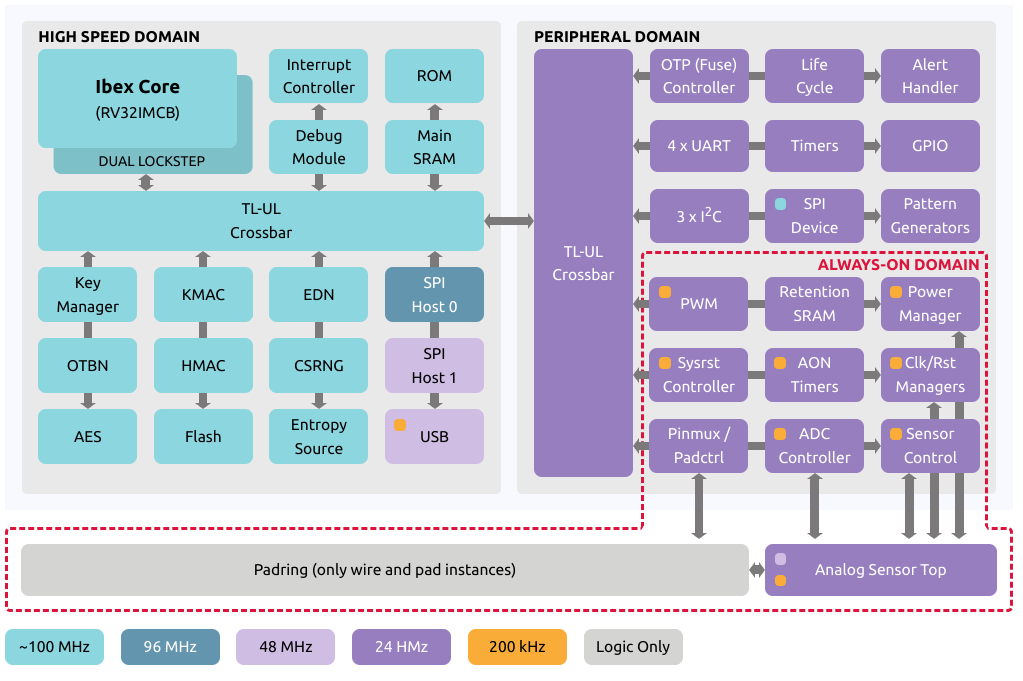
Earl Grey: Discrete implementation of OpenTitan

Design Verification

Industrial quality implementation has been a core tenet of the OpenTitan project from the outset, both to ensure the design meets its goals—including security—and to ensure the first physical chips are successful. OpenTitan’s hardware development stages ensure all hardware blocks go through several gating design and verification reviews before final integration signoff. This verification has required development of comprehensive testbenches and test infrastructure, all part of the open source project. Both individual blocks and the top-level Earl Grey design have functional and code coverage above 90%—at or above the standards of typical closed-source designs—with 40k+ tests running nightly and reported publicly via the OpenTitan Design Verification Dashboard. Regressions are caught and resolved quickly, ensuring design quality is maintained over the long term.

Software tooling

OpenTitan has led the way in making open source silicon a reality, and doing so requires much more than just open source silicon RTL and Design Verification collateral. Successful chips require real software support to have broad industry impact and adoption. OpenTitan has created generalizable infrastructure for silicon projects (test frameworks, continuous integration infrastructure, per-block DIFs), host tools like opentitantool to support interactions with all OpenTitan instances, and formal releases (e.g. the ROM to guarantee important security functionality such as firmware verification and ownership transfer).

Documentation

A good design isn’t worth much if it’s hard to use. With this in mind, thorough and accurate documentation is a major component of the OpenTitan project too. This includes a Getting Started Guide, which is a ‘from scratch’ walkthrough on a Linux workstation, covering software and tooling installation, and hardware setup. It includes a playbook to run local simulations or even emulate the entire OpenTitan chip on an FPGA.

Furthermore, OpenTitan actively maintains live dashboards of quality metrics for its entire IP ecosystem (e.g. regression testing and coverage reports). If you’re new to open source silicon development, there are comprehensive resources describing project standards for technical contribution that have been honed to effectively facilitate inter-organizational collaboration.

Thriving open source community

OpenTitan’s broad community has been critical to its success. As the following metrics show (baselined from the project’s public launch in 2019), the OpenTitan community is rapidly growing:

  • More than eight times the number of commits at launch: from 2,500 to over 20,000.
  • 140 contributors to the code base
  • 13k+ merged pull requests
  • 1.5M+ LoC, including 500k LoC of HDL
  • 1.8k Github stars

Participating in OpenTitan

Reaching this key RTL freeze milestone is a major step towards transparency at the very foundation of the security stack: the silicon root of trust. The coordinated contributions of OpenTitan’s project's partners—enabled by lowRISC’s Silicon Commons™ approach to open source silicon development—are what has enabled us to get here today.

This is a watershed moment for the trustworthiness of systems we all rely on. The future of free and open, high quality silicon implementations is bright, and we expect to see many more devices including OpenTitan top-levels and ecosystem IP in the future!

If you are interested in contributing to OpenTitan, visit the open source GitHub repository or reach out to the OpenTitan team.

By Cyrus Stoller, Miguel Osorio, and Will Drewry, OpenTitan – Google

.