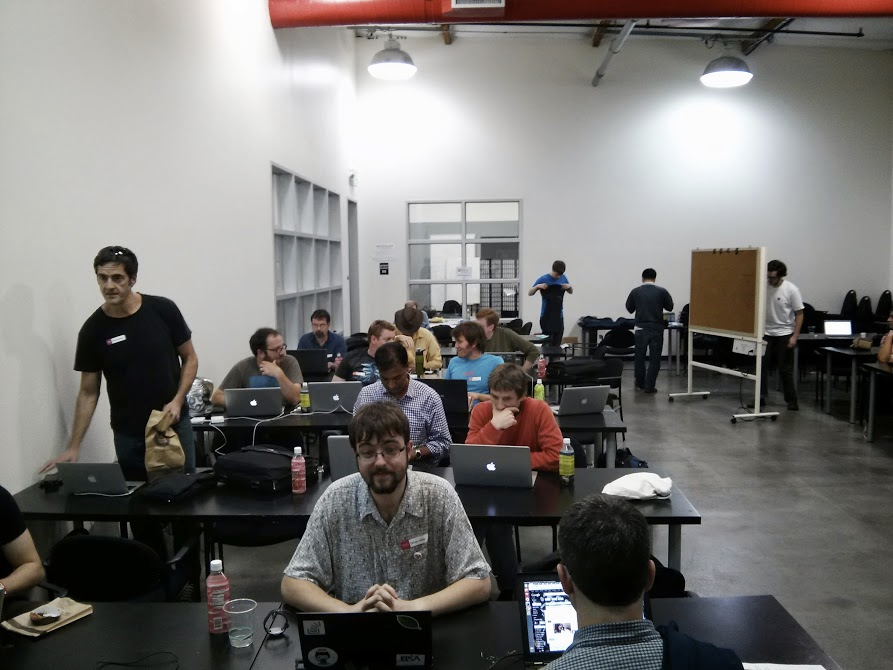
Last weekend saw the 2013 edition of BayHac: a two and half day hackathon for Haskell programmers. This year's event was held at Hacker Dojo’s lovely new space in Mountain View, California. Attendance was the highest yet with over 70 people on Saturday alone. Attendees were from every skill levels, from padawan to Jedi master and everything in between.
In addition to the mainstay of hacking on a wide range of projects with the kind assistance of those around you, BayHac '13 also had some more structured events. A three hour Code Kata session had 10 teams of two working on crafting elegant code solutions to a program that evolved over the course of the session. Then the teams shared their solutions and we learned how many different ways one can approach even simple problems.
Two sessions of lightning talks saw 17 presentations on topics as diverse as protein searching, category theory, explaining charts to the blind, music composition, meta programming, and wrapping a new regular expression library.
This year, thanks to a generous sponsorship from Google, BayHac included lunch, which as you can see below, was well received and helped fuel the day's hacking.
By Mark Lentczner, Software Engineer, and BayHac organizer
Open Standard Color Font Fun for Everyone
Wednesday, May 29, 2013
People love using Emoji to communicate—it started in Japan and then spread through Asia and is becoming increasingly popular in the rest of the world. Instead of texting "How about going for a burger and beer at 7pm?", it’s much more fun to say,
To make this possible everywhere, we are releasing an open standard for color fonts and have added support for it to one of the most popular font rendering engines in the world—FreeType.
We want to make color Emoji available in an open and free way anywhere that you use text. Before the release of this new open standard, the use of color glyphs has been limited to systems doing special text processing and inserting images into the text or by using closed proprietary font formats. Both of those approaches have serious limitations. They make it difficult for developers to support color text in their applications and it is impossible for users to change the images used for the characters.
We are releasing four pieces to help developers start adding support to their systems:
- specification for enhancements to the OpenType standard
- source changes to the FreeType rendering engine and the Skia 2D graphics library
- a tool to embed color glyphs into fonts
- three sample color fonts
These are all freely available to download and use from the Color Emoji Font Project site. Further, the changes to FreeType have also been integrated into the main code repository.
While color emoji may be the initial motivation for adding color to fonts, it is not the only reason to do so. Color fonts allow for a huge amount of extra expressive power. How about a font made from color images of fruit or a font that looks like extruded plastic blocks? You don’t have to imagine them -- have a look at the text that starts this blog post, it was produced using the FruityGirl font. You can download this font as well as Funkster from our project site and a prototype emoji font built from the Phantom Open Emoji images. These fonts show just a hint of what is possible.
This new format for storing color glyphs in fonts will allow for more expressive communication in everything you use. We hope that providing this open source release will truly bring a more colorful tomorrow!
Note: What appears to be color fonts in this blog post have been simulated. There is not yet a way to show these in text form until this technology makes its way into the products that you use. The work we have released is the first step in this process. We are working to get all of the other pieces in place.By Behdad Esfahbod and Stuart Gill, Font and Text Team, Google Internationalization Engineering
Students Announced for Google Summer of Code 2013
Monday, May 27, 2013
Congratulations to the 1,192 students accepted for our 2013 Google Summer of Code! It was tough for the 177 mentoring organizations to choose from the huge number of applications we received - 5999 proposals from 4,144 students - and we want to thank everyone who applied.
Students will now enter the community bonding period where they will get to know their mentors and prepare for the program by reading documentation, hanging out in the IRC channel and familiarizing themselves with their new community before beginning their actual coding in June.
If you are interested in learning more about the 177 organizations that the students will be working with during the summer or important dates, please visit the program website.
We look forward to an exciting and productive summer of coding.
By Carol Smith, Open Source Programs Office
Students will now enter the community bonding period where they will get to know their mentors and prepare for the program by reading documentation, hanging out in the IRC channel and familiarizing themselves with their new community before beginning their actual coding in June.
If you are interested in learning more about the 177 organizations that the students will be working with during the summer or important dates, please visit the program website.
We look forward to an exciting and productive summer of coding.
By Carol Smith, Open Source Programs Office
A Change to Google Code Download Service
Monday, May 20, 2013
Project Hosting on Google Code provides a free collaborative development environment for open source projects. Each project comes with its own member controls, Subversion/Mercurial/Git repository, issue tracker, wiki pages, and downloads service.
Downloads were implemented by Project Hosting on Google Code to enable open source projects to make their files available for public download. Unfortunately, downloads have become a source of abuse with a significant increase in incidents recently. Due to this increasing misuse of the service and a desire to keep our community safe and secure, we are deprecating downloads.
Starting today, existing projects that do not have any downloads and all new projects will not have the ability to create downloads. Existing projects with downloads will see no visible changes until January 14, 2014 and will no longer have the ability to create new downloads starting on January 15, 2014. All existing downloads in these projects will continue to be accessible for the foreseeable future.
If your project is using downloads to host and distribute files and has a need to periodically create new downloads, we recommend you move your downloads to an alternate service like Google Drive before January 15, 2014. If you choose to move your files to Google Drive, check out our help article.
Downloads were implemented by Project Hosting on Google Code to enable open source projects to make their files available for public download. Unfortunately, downloads have become a source of abuse with a significant increase in incidents recently. Due to this increasing misuse of the service and a desire to keep our community safe and secure, we are deprecating downloads.
Starting today, existing projects that do not have any downloads and all new projects will not have the ability to create downloads. Existing projects with downloads will see no visible changes until January 14, 2014 and will no longer have the ability to create new downloads starting on January 15, 2014. All existing downloads in these projects will continue to be accessible for the foreseeable future.
If your project is using downloads to host and distribute files and has a need to periodically create new downloads, we recommend you move your downloads to an alternate service like Google Drive before January 15, 2014. If you choose to move your files to Google Drive, check out our help article.
By Google Project Hosting
Google Summer of Code meetups, Episode 8: Lahore, Pakistan
Friday, May 17, 2013
The Google Developer Group (GDG) Lahore hosted their fourth event on the afternoon of April 18th with support from Plan9 (Tech Incubator) and P@SHA. The event had a variety of attendees, from early Computer Science students to soon-to-be graduates, to industry professionals and faculty members from various universities in Lahore, Pakistan.
As part of the event agenda, GDG Lahore hosted a panel about Google Summer of Code where Muhammad Adnan shared his experiences from Google Summer of Code as a both a student and a mentor. Muhammad was a Google Summer of Code student in the 2010 program for phpMyAdmin and a Mentor for RTEMS in Google Summer of Code 2012 and Mentor for Google Code-in 2011 and 2012.
Adnan shared his story about how he first discovered the program through Twitter and ultimately applied for the Google Summer of Code program. He motivated students who were interested in applying for Google Summer of Code and gave them tips on writing their applications. Adnan explained how Google is providing opportunities for student developers to show their skills and how to increase the chances of their proposal being accepted by the mentoring organizations involved in this year’s Google Summer of Code. The session ended with questions from attendees about Google Summer of Code and its many benefits.
Historically, Google Summer of Code hasn’t had very many entries from Pakistan, possibly because many students are not familiar with Google Summer of Code here. The main purpose of this session was to let students know more about the program and encouraging students to apply. GDG Lahore plans to brings a similar session Google Summer of Code in many other universities in Lahore in the coming months.
By Haris Nadeem , GDG Lahore Manager
As part of the event agenda, GDG Lahore hosted a panel about Google Summer of Code where Muhammad Adnan shared his experiences from Google Summer of Code as a both a student and a mentor. Muhammad was a Google Summer of Code student in the 2010 program for phpMyAdmin and a Mentor for RTEMS in Google Summer of Code 2012 and Mentor for Google Code-in 2011 and 2012.
Adnan shared his story about how he first discovered the program through Twitter and ultimately applied for the Google Summer of Code program. He motivated students who were interested in applying for Google Summer of Code and gave them tips on writing their applications. Adnan explained how Google is providing opportunities for student developers to show their skills and how to increase the chances of their proposal being accepted by the mentoring organizations involved in this year’s Google Summer of Code. The session ended with questions from attendees about Google Summer of Code and its many benefits.
Historically, Google Summer of Code hasn’t had very many entries from Pakistan, possibly because many students are not familiar with Google Summer of Code here. The main purpose of this session was to let students know more about the program and encouraging students to apply. GDG Lahore plans to brings a similar session Google Summer of Code in many other universities in Lahore in the coming months.
By Haris Nadeem , GDG Lahore Manager


