opensource.google.com

Menu
Showing posts with label JAX. Show all posts

Leveraging CPU memory for faster, cost-efficient TPU LLM training

Friday, April 10, 2026

Intel Xeon 6 Processor

Host offloading with JAX on Intel® Xeon® processors

As Large Language Models (LLMs) continue to scale into the hundreds of billions of parameters, device memory capacity has become a big limiting factor in training, as intermediate activations from every layer in the forward pass are needed in the backward pass. To reduce device memory pressure, these activations can be rematerialized during the backward pass, trading memory for recomputation. While rematerialization enables larger models to fit within limited device memory, it significantly increases training time and cost.

Intel® Xeon® processors (5th and 6th Gen) with Advanced Matrix Extensions (AMX) enable practical host offloading of selected memory- and compute-intensive components in JAX training workflows. This approach can help teams train larger models, relieve accelerator memory pressure, improve end-to-end throughput, and reduce total cost of ownership—particularly on TPU-based Google Cloud instances.

By publishing these results and implementation details, Google and Intel aim to promote transparency and share practical guidance with the community. This post describes how to enable activation offloading for JAX on TPU platforms and outlines considerations for building scalable, cost-aware hybrid CPU–accelerator training workflows.

Figure 1. Google Cloud TPU Pod commonly used in LLM training.

Host offloading

Traditional LLM training is usually done on device accelerators alone. However, modern host machines have much larger memory size than accelerators (512GB or more) and can offer extra compute power, e.g., TFLOPS in case of Intel® Xeon® Scalable Processor with AMX capability. Leveraging host resources can be a great alternative to rematerialization. Host offloading selectively moves computation or data between host and device to optimize performance and memory usage.

Host memory offloading keeps frequently-accessed tensors on the device and spills the rest to CPU memory as an extra level of cache. Activation offloading transfers activations computed on-device in the forward pass to the host, stores them in the host memory, and brings them back to the device in the backward pass for gradient computation. This unlocks the ability to train larger models, use bigger batch sizes, and improve throughput.

Figure 2: Memory offloading during forward and backward pass

In this blog post, we provide a practical guide to offload activations through JAX to efficiently train larger models on TPUs with an Intel® Xeon® Scalable Processor.

Enabling memory offloading in JAX

JAX offers multiple strategies for offloading activations, model parameters, and optimizer states to the host. Users can use checkpoint_names() to create a checkpoint for a tensor. The snippet below shows how to create a checkpoint  x:

from jax.ad_checkpoint import checkpoint_name 
 
def layer_name(x, w): 
  w1, w2 = w 
  x = checkpoint_name(x, "x") 
  y = x @ w1 
  return y @ w2, None  

Users can provide checkpoint_policies() to select the appropriate memory optimization strategy for intermediate values. There are three strategies:

  1. Recomputing during backward pass (default behavior)
  2. Storing on device
  3. Offloading to host memory after forward pass and loading back during backward pass

The code below moves x from device to the pinned host memory after the forward pass.
from jax import checkpoint_policies as cp

policy = cp.save_and_offload_only_these_names( 
  names_which_can_be_saved=[],         # No values stored on device 
  names_which_can_be_offloaded=["x"],  # Offload activations labeled "x" 
  offload_src="device",                # Move from device memory 
  offload_dst="pinned_host"            # To pinned host memory 
) 

Measuring Host Offloading Benefits on TPU v5p

We examined TPU host-offloading on JAX on both fine-tuning and training workloads. All our experiments were run on Google Cloud Platform, using a single v5p-8 TPU instance with single host 4th Gen Intel® Xeon® Scalable Processor.

Fine-tuning PaliGemma2: Using the base PaliGemma2 28B model for vision-language tasks, we fine-tuned the attention layers of the language model (Gemma2 27B) while keeping all other parameters frozen. During fine-tuning, we set the LLM sequence length to 256 and the batch size to 256.

The default checkpoint policy is nothing_saveable, which does not keep any activations on-device during the forward pass. The activations are rematerialized during the backward pass for gradient computation. While this approach reduces memory pressure on the TPU, it increases compute time. To apply host offloading, we offload Q, K, and V projection weights using save_and_offload_only_these_names. These activations are transferred to host memory (D2H) during the forward pass and fetched back during the backward pass (H2D), so the device neither stores nor recomputes them. Figure 2 shows 10% reduction in training time from host offloading. This translates directly into a similar reduction in TPU core-hours, yielding meaningful cost savings. The complete fine-tuning recipe is available at [JAX host offloading].

Figure 3: (Top) Training time comparison between full rematerialization and host offloading.
(Bottom) Memory analysis with and without host offloading.

Training Llama2-13B using MaxText: MaxText offers several rematerialization strategies that can be specified in the training configuration file. We used the policy remat_policy: 'qkv_proj_offloaded' to offload Q, K, and V projection weights. Figure 3 shows ~5% reduction in per-step training time compared to fully rematerializing all activations ( remat_policy: 'full').

Figure 4: MaxText Llama2-13B training statistics with and without host offloading.
The step time was 5% faster with host offloading.

When to offload activations

Activation offloading is beneficial when the time to transfer activations across host and device is lower than the time to recompute them. The timing depends on multiple factors such as PCIe bandwidth, model size, batch size, sequence length, activation tensor sizes, compute capabilities of the device, etc. An additional factor is how much the data movement can be overlapped with computation to keep the device busy. Figure 4 demonstrates an efficient overlap of the device-to-host transfer with compute during the backward pass in PaliGemma2 28B training.

Figure 5: A JAX trace of PaliGemma2 training viewed on Perfetto.
Memory offloading overlaps with compute effectively during backward pass host to device.

Smaller model variants such as PaliGemma2 3B and 9B did not see benefits from host offloading because it is faster to rematerialize all tensors than to transfer them to and from the host. Therefore, identifying the appropriate workload and offloading policy is crucial to realizing performance gain from host offloading

Call to Action

If you train on TPUs and are limited by device memory, consider evaluating activation offloading. Start by labeling candidate activations (for example, Q/K/V projections) and compare step time, memory headroom, and overall cost across representative workloads.

In our experiments, we observed up to ~10% improvement in end-to-end training time for larger workloads, which can reduce total cost of ownership (TCO) by shortening time-to-train or enabling the same workload on smaller instances.

Acknowledgments

Emilio Cota, and Karlo Basioli from Google and Eugene Zhulenev (formerly at Google).

Training Marin 32B: What an open lab can build with TPUs, JAX, and a little persistence

Thursday, December 18, 2025

Last summer, we partnered with Google to share how Marin trained a fully open 8B foundation model using JAX and TPUs. Since then, our process hasn't changed much, but the scale has. Over the summer, we trained a 32B model entirely in the open, and most days there was just one person keeping the run moving.

Large-scale training is usually associated with big teams and bigger infrastructure. Large model releases typically have hundreds of authors. Marin tests a different hypothesis: using open source software and data, small teams can train serious foundation models if the tooling is good, the platform is stable, and the process is transparent. The Marin 32B run was our strongest validation yet.


A model built with one hand on the helm

Marin was started at Stanford University's Center for Research on Foundation Models with the goal of building radically open foundation models. In May, we released Marin 8B Base, which bested the popular Llama 3.1 8B Base on 14 of 19 benchmarks. Marin 8B was trained using Google TPU v4 and TPU v5e from the TPU Research Cloud.

Building on that success, we set out to build a 32B model starting in June. Our 32B training run followed Marin's usual "Tootsie Roll" style: start with a solid recipe, instrument heavily, and adapt mid-flight when necessary. That flexibility matters, because the first time you train at a larger scale, issues inevitably arise.

The timing, however, was less than ideal, as universities tend to empty out over the summer. Students graduate, get internships, go home, or travel the world. Marin was no different. By June, our team was down to one full time research engineer, with a few PhD students providing guidance when they weren't busy with their dissertations. Nevertheless, we pushed forward.

To spoil the ending, the model turned out quite well. On release, Marin 32B Base was the best open source base model, and it outperformed comparable open-weights models like Google's Gemma 3 27B PT on 24 of 42 base-model evaluations.

There were many bumps along the way, resulting in multiple mid-run corrections, but through it all Google's TPU infrastructure stayed rock-solid, and JAX's predictable performance let us iterate quickly. This meant that even with a tiny team, we could diagnose, patch, and continue training without losing momentum.

To be blunt: one researcher kept the 32B run alive all summer, juggling preemptible slices, rebuilding optimizer state, switching architectures, and generally shepherding ~6.4 trillion tokens across v5p and v4 pods—while mostly working on other Marin projects. The fact that this was possible speaks to the stability of the TPU platform and the maturity of the JAX/Marin stack.

The short version of a long summer

Our retrospective goes into much more detail about every spike, switch and cooldown. Here's the condensed version.

We began with a Llama-3-style 32B backbone and our best 8B data mix, running on preemptible TPU v5p pods. Preemptions were predictable, and recovery was nearly automatic. As availability tightened, however, we moved to dedicated TPU v4 capacity. After a slight tweak to gradient checkpointing to accommodate the older hardware (made easy by JAX's built-in support), we were back up and running and performance stayed excellent.

Around 70k steps, persistent loss spikes appeared. We tried clipping, update-norm guards, skip-step heuristics, "necromancy" (rebuilding optimizer state), and swapping in optimizers like Muon. Nothing helped. The model needed architectural support.

So, we warm-started the run onto a Qwen3-style architecture, which is the same as the Llama 3 architecture, except that it adds QK-Norm to attention. After a brief loss bump, the spikes vanished. The model recovered to its expected trajectory within ~10 billion tokens and remained stable.

Towards the end of training, it was time for a cool down. When training LLMs, one "cools down" the model by lowering the learning rate and changing the data mix to higher quality data. Our first cooldown surfaced two issues: contamination from a cached math dataset, and a training-loss phase shift caused by our linear-congruential shuffle. Switching to a Feistel-based shuffle fixed the latter completely. After cleaning the data and re-running the cooldown, the second cooldown was smooth and produced the final model.

The result: a strong, open 32B base model

Marin 32B Base is a competitive open-source base model. It outperformed Olmo 2 32B Base—the previous best fully open-source base model—on 32 of 42 tasks, and it performs especially well on knowledge-heavy evaluations like ARC, BoolQ, and PIQA.

Head-to-head, Marin 32B Base also beat Gemma 3 27B PT on 24 of 42 tasks, and its overall average rank places it alongside Qwen 2.5 32B and the newer Olmo 3 32B models. On our evaluation suite, Marin 32B Base actually ties Olmo 3 32B Base in win rate, despite Olmo 3 being trained by a much larger team and arriving a month later.

Mean rank across our evaluation suite (lower is better). Marin 32B Base lands in the top cluster of open(-weight) models, alongside Qwen 2.5 and Olmo 3, and ahead of Gemma 3 27B PT and Olmo 2 32B. Gray bars indicate open weight models, while blue bars indicate open source models.

While Olmo 3 32B Base now comfortably leads on math and coding benchmarks, Marin 32B Base holds its own and still leads on many knowledge QA evaluations. For a model trained with a fraction of the team size typically expected for a 30B-scale run, we're proud of where it landed.

Because Marin 32B Base (like Olmo 3 32B) is open source, the weights, code, data recipes, and every experimental detour are public. Anyone can reproduce, audit, or build on the work.


The stack that made it possible

TPU stability across large slices

During the run, we moved across preemptible v5p-512 slices coordinated with Cloud TPU Multislice, a v4-2048 slice for the long middle, and several mid-run architectural transitions. Throughout, TPUs were completely reliable for us: no mysterious hangs, no collective-op debugging. Preemptions were predictable and easy to recover from.

JAX + Levanter = predictable performance

Levanter builds on JAX's XLA compilation. In practice, what mattered for us was deterministic restarts, stable MFU at scale without custom kernels, and JAX's activation checkpointing, which made the v5p to v4 migration easy.

Marin's experiment system

Marin logs every step of the experimental pipeline: hyperparameters, code versions, datasets, metrics, and artifacts. Even with architectural switches and restarts, the run never devolved into a tangle of scripts. And because it's all open, anyone can retrace or reproduce the training.

What's next

Marin 32B Base is a strong base model, but we're not done. Here's what's coming next:

  • A reasoning-optimized Marin 32B
  • Hardened multislice TPU support for smoother preemptible training
  • Exploring MoE variants for the next scale
  • Continuing to release everything, including successes and failures, openly

Closing thought

Training a 32B model with a small team isn't about heroics but about using the right tools and infrastructure. TPUs' reliability, JAX's clarity and performance, and Marin's open, reproducible process provided the leverage we needed. If the 8B run showed that open labs can build credible models, the 32B run showed they can do it at scale: quietly, steadily, and with far fewer people than you might expect.

SpatialReasoner: Teaching VLMs to "see" structure — Accelerated with Tunix on TPUs

Wednesday, December 17, 2025

Introduction

We are seeing an increasing interest in Tunix among researchers focusing on the post-training phase of model development. As a native JAX library, Tunix offers the flexibility needed to refine foundation models—including Vision-Language Models (VLMs) and not just LLMs—helping them significantly improve their spatial reasoning capabilities.

Today, we are highlighting the work of the PLAN Lab (Perception and LANguage Lab) at the University of Illinois Urbana-Champaign (UIUC). To address the critical lack of spatial awareness in VLMs, they built SpatialReasoner-R1, a model capable of fine-grained spatial logic. They utilized Tunix and leveraged the Google TPU Research Cloud (TRC) to scale their experiments.

In this blog, Professor Ismini Lourentzou and her team explain how they used Tunix's modular design to implement novel alignment algorithms and improve spatial reasoning in VLMs.

The "Where" Problem in VLMs

Modern Vision-Language Models (VLMs) can describe images and answer basic visual questions with impressive fluency. However, they often struggle with fine-grained spatial understanding. If you ask a VLM to estimate distances, directions, or the precise relative positions of objects, it frequently "hallucinates" coordinates or produces inconsistent reasoning with vague answers.

These capabilities are critical for real-world applications, such as robotics, where precise spatial reasoning enables safe and intelligent interaction with physical environments.

To bridge this gap, we developed the SpatialReasoner-R1 (4B and 8B versions), a model trained to perform step-by-step visually grounded spatial reasoning. It achieves 95.59 on Qualitative Accuracy and 77.3 on Quantitative Accuracy for our 8B fDPO model, outperforming the strongest baseline by ~9% in average accuracy on the SPATIALRGPT-Bench while preserving strong general vision-language abilities.

The Method: Fine-Grained Direct Preference Optimization (fDPO)

The secret sauce behind SpatialReasoner-R1 is a new technique called Fine-Grained Direct Preference Optimization (fDPO).

Standard alignment methods (like DPO) usually give a model a simple "thumbs up" or "thumbs down" for an entire response. But spatial reasoning is complex— for example, a model might correctly identify an object yet make a flawed logical inference about its location.

fDPO introduces segment-specific preference granularity. We optimize separate loss components for:

  1. Descriptive Grounding: Does the model correctly perceive and describe the objects in the image?
  2. Logical Reasoning: Is the step-by-step deduction sound and follows coherent spatial logic?

To generate high-quality training signals, we built a Multi-Model Monte Carlo Tree Search (M3CTS) data generation pipeline, which constructs diverse reasoning trajectories that guide the model toward reliable spatial understanding.

Tunix: Modularity for Novel Research

Implementing a custom objective like fDPO can be difficult in rigid frameworks. Tunix addresses this by providing a well-structured and extensible DPOTrainer that makes it possible to introduce new alignment objectives without reengineering the training pipeline.

This modularity meant we could reuse the entire underlying training stack—sharding, data loading, and loop management—while injecting our novel research logic with just a small amount of well-contained code.

While our backbone model (Sa2VA) required specific architectural handling, the core fDPO algorithm is model-agnostic. We found the Tunix experience smooth and well-documented, making it easy to prototype and iterate on fine-tuning workflows without reinventing the wheel.

Google TRC & TPUs: Reliability at Scale

Training a model to reason over long horizons requires significant compute. The Google TPU Research Cloud (TRC) provided the infrastructure we needed to make large-scale training practical.

  • Scalability: Tunix's integration with TPUs allowed us to scale our experiments seamlessly.
  • Reliability: The system performed reliably across multiple TPU runs, which was essential for conducting large-scale spatial reasoning benchmarks.
  • Support: The Google Tunix and TRC teams assisted with infrastructure setup and experiment design, helping us refine our multi-model exploration strategy.

Looking Ahead: Open Source Contributions

We believe that open-source, extensible tools like Tunix are vital for fostering innovation. They lower the barrier for researchers to experiment with new training objectives without rebuilding core infrastructure.

In that spirit, we contributed our fDPO implementation back to the Tunix ecosystem. We open-source the core fDPO components, enabling the community to apply segment-specific preference optimization to their own models.

Get Started

You can explore our research and the tools we used below:

ESCA: Grounding embodied agents with scene graphs — Accelerated by JAX

Monday, December 15, 2025


Introduction

Multi-Modal Language Models (MLLMs) are increasingly forming the core of the brain for general-purpose embodied agents — AI that can navigate and act in the physical world as robots. While MLLMs are making rapid progress, they often stumble on a critical hurdle: precise visual perception. They struggle to reliably capture the fine-grained links between low-level visual features and high-level textual semantics.

Today, we are highlighting the work of Prof. Mayur Naik's research team at the University of Pennsylvania. To bridge the gap between high-level language and low-level visual features, they developed ESCA (Embodied and Scene-Graph Contextualized Agent). By porting their neurosymbolic pipeline to JAX, they achieved the real-time performance necessary for high-throughput decision-making. This work also demonstrates that JAX drives performance gains across a wide range of hardware, including standard CPUs and NVIDIA GPUs, and not just on Google TPUs.

In this blog, the UPenn team explains how they combined structured scene graphs with JAX's functional design to reduce perception errors by over 50% and achieve a 25% speedup in inference.


The "Grounding" Problem in Embodied AI

Existing MLLMs are powerful, but they can be surprisingly "blind" when tasked with interacting with the physical world. In our empirical analysis of 60 navigation tasks from EmbodiedBench, we found that 69% of agent failures stemmed from perception errors. See the figure below.

The three top-level error types are Perception, Reasoning, and Planning. The second-level errors are Hallucination, Wrong Recognition, Spatial Understanding, Spatial Reasoning, Reflection Error, Inaccurate Action, and Collision. For clarity, the figure uses these acronyms to label the different error types.

The models struggle to capture fine-grained links between visual features and textual semantics. They might recognize a "kitchen," but fail to identify the specific spatial relationship between a knife and a cutting board required to complete a task.

Enter ESCA: The Anglerfish of AI

To solve this, we introduced ESCA, a framework designed to contextualize MLLMs through open-domain scene graph generation.

Think of ESCA like the bioluminescent lure of a deep-sea anglerfish. Just as the fish illuminates its dark surroundings to reveal prey, ESCA "illuminates" the agent's environment by generating a structured Scene Graph—a map of objects, attributes, and relationships (e.g., Cup [Red] ON Table).

A key innovation here is Selective Grounding. Injecting a massive scene graph of everything in the room can overwhelm the model. Instead, ESCA identifies only the subset of objects and relations pertinent to the current instruction. It performs probabilistic reasoning to construct prompts enriched with exactly the contextual details the agent needs to act.

The Engine: LASER and Scallop

At the core of ESCA is LASER, a CLIP-based foundation model trained on 87k video-caption pairs. LASER uses Scallop—our neurosymbolic programming language that supports JAX backends—to align predicted scene graphs with logical specifications. This pipeline allows us to train low-level perception models to produce detailed graphs without needing tedious frame-level annotations.

JAX User Experience

1. The Power of Statelessness

JAX's design encouraged a fully functional, stateless architecture. Every component, from feature extraction to similarity computation, was made into a pure modular function. This structure enabled effective use of jit (Just-In-Time) compilation. The XLA compiler could fuse sequences—like normalization, matrix multiplication, and softmax—into fewer kernels, reducing intermediate buffers and lowering GPU overhead.

2. Handling Complex Control Flow

Our pipeline requires selecting the "top-k" most relevant objects from a probabilistic scene graph. This introduces complex control flow. JAX provided the primitives we needed to handle this efficiently:

  • We used jax.lax.cond to manage control flow inside the probabilistic graph.
  • We leveraged jax.nn and jax.numpy for all activation functions and batched math in a JIT-friendly way.

3. Debugging and Transparency

Migrating to JAX was also a learning experience. Tools like jax.debug.print/callback() allowed us to inspect values inside jit-compiled functions, while jax.disable_jit() let us easily switch to eager execution to step through the program seeing intermediate values.

Furthermore, the transparency of the open-source system was impressive. Being able to read the annotated source code and see how Python functions trace into jaxpr (JAX expression) gave us deep insight into how to design inference logic that scales.

4. Seamless Integration with Flax

NNX fits into our workflow perfectly. We used nnx.Module to structure the model and FrozenDict to keep parameters organized and immutable. The TrainState object made managing model parameters and optimizer states straightforward, without adding the complexity often found in other frameworks.

JAX Performance: A 25% Speedup

Embodied agents operate in a continuous loop: planning, acting, and updating their understanding of a dynamic world. High latency here is a dealbreaker. We ported LASER from PyTorch to JAX to improve real-time performance, and the benefits were significant. By rewriting our core similarity computations and feature pipelines as pure functions wrapped in jax.jit, we achieved significant gains.

On an NVIDIA H100 GPU, JAX reduced the average time per frame from 18.15 ms (PyTorch) to 14.55 ms (JAX)—a roughly 25% speedup.

Framework

Hardware

Avg Time Per Frame (ms) ↓

FPS ↑

PyTorch

H100 GPU

18.15 ± 0.73

55.15 ± 2.31

JAX

H100 GPU

14.55 ± 0.64

68.82 ± 3.13

Conclusion

ESCA demonstrates that better data—structured, grounded scene graphs—can solve the perception bottleneck in Embodied AI. But it also demonstrates that better infrastructure is required to run these systems in the real world. JAX provided the speed, transparency, and modularity needed to turn our research into a real-time agent capable of reliable reasoning.

Acknowledgements

This research was made possible through support from a Google Research Award to the University of Pennsylvania and from the ARPA-H program on Safe and Explainable AI under award D24AC00253-00.

Get Started

You can explore the LASER code, the ESCA framework and documentation for JAX and Flax at:

A Robust Open Ecosystem for All: Accelerating AI Infrastructure

Tuesday, December 3, 2024


JAX now runs on AWS Trainium: Open Source Fuels AI Innovation

Open source software is the foundation of machine learning. It accelerates innovation through an ethos of flexibility and collaboration. This philosophy drives the open development of JAX, our high-performance array computing library, as well as OpenXLA, the compiler and runtime infrastructure it relies on.

Today we're excited to highlight how this commitment to openness, together with JAX and OpenXLA's modular designs, enables seamless integration of AWS Trainium and Trainium2 chips accelerators into the JAX ecosystem. Users get more portability, more choice, and faster progress.


JAX and OpenXLA, abstraction and modularity

JAX is a Python library for high-performance, large-scale numerical computing and machine learning. Its unique compiler-oriented design makes numerical computation familiar and portable while also accelerator-friendly and scalable. It combines a NumPy-like API with composable transformations for automatic differentiation, vectorization, parallelization, and more. Under the hood, JAX leverages the XLA compiler to optimize and scale computations over a broad set of backends.

This abstraction layer is key to its portability: JAX presents a consistent interface while XLA optimizes performance, whether you're running on CPUs, GPUs, TPUs, or something new.

In fact, OpenXLA infrastructure is designed to be modular and extensible to new platforms. By developing a PJRT plugin and leveraging existing XLA compiler components, JAX code can target new platforms, even when scaling from a single device to thousands.


Enter AWS Trainium and Inferentia

We are excited to announce that AWS Trainium is the latest platform to embrace JAX and OpenXLA. With the JAX Neuron plugin, AWS Trainium and Inferentia can be used as native JAX devices.

This new backend demonstrates how abstraction and modularity make JAX and OpenXLA especially extensible and amenable to collaboration, even on new hardware. We're thrilled to have diverse hardware partners like AMD, Arm, Intel, Nvidia, and AWS taking advantage of JAX's portability and performance. If you're interested in bringing new platforms into the JAX and OpenXLA ecosystem, please reach out!

A multi-platform ecosystem fosters open collaboration in advancing AI infrastructure. Our goal is to drive continuous development of open standards and to accelerate progress. And if you're a machine learning developer or numerical computing user, we're excited for you to try JAX on any platform you choose.

By Matthew Johnson - Principal Scientist, with additional contributors: Aditi Joshi, Fenghui Zhang, Roy Frostig, and Carlos Araya

Controlling Stable Diffusion with JAX, diffusers, and Cloud TPUs

Wednesday, June 14, 2023

Diffusion models are state-of-the-art in generating photorealistic images from text. These models are hard to control through only text and generation parameters. To overcome this, the open source community developed ControlNet (GitHub), a neural network structure to control diffusion models by adding more conditions on top of the text prompts. These conditions include canny edge filters, segmentation maps, and pose keypoints. Thanks to the 🧨diffusers library, it is very easy to train, fine-tune or control diffusion models written in various frameworks, including JAX!

At Hugging Face, we were particularly excited to see the open source machine learning (ML) community leverage these tools to explore fun and creative diffusion models. We joined forces with Google Cloud to host a community sprint where participants explored the capabilities of controlling Stable Diffusion by building various open source applications with JAX and Diffusers, using Google Cloud TPU v4 accelerators. In this three week sprint, participants teamed up, came up with various project ideas, trained ControlNet models, and built applications based on them. The sprint resulted in 26 projects, accessible via a leaderboard here. These demos use Stable Diffusion (v1.5 checkpoint) initialized with ControlNet models. We worked with Google Cloud to provide access to TPU v4-8 hardware with 3TB storage, as well as NVIDIA A10G GPUs to speed up the inference in these applications.

Below, we showcase a few projects that stood out from the sprint, and that anyone can create a demo themselves. When picking projects to highlight, we considered several factors:

  • How well-described are the models produced?
  • Are the models, datasets, and other artifacts fully open sourced?
  • Are the applications easy to use? Are they well described?

The projects were voted on by a panel of experts and the top ten projects on the leaderboard won prizes.

Control with SAM

One team used the state-of-the-art Segment Anything Model (SAM) output as an additional condition to control the generated images. SAM produces zero-shot segmentation maps with fine details, which helps extract semantic information from images for control. You can see an example below and try the demo here.

Screencap of the 'Control with SAM' project

Fusing MediaPipe and ControlNet

Another team used MediaPipe to extract hand landmarks to control Stable Diffusion. This application allows you to generate images based on your hand pose and prompt. You can also use a webcam to input an image. See an example below, and try it yourself here.

Screencap of a project fusing MediaPipe and ControlNet

Make-a-Video

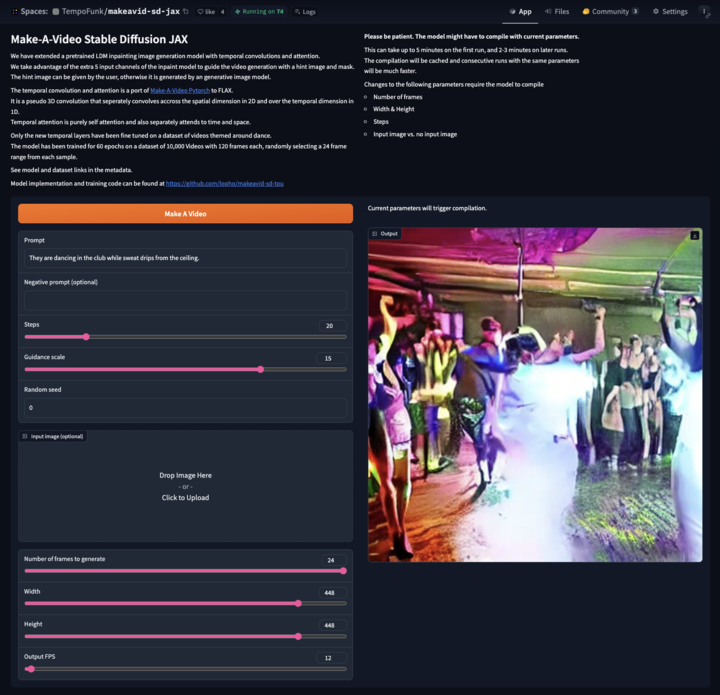
Top on the leaderboard is Make-a-Video, which generates video from a text prompt and a hint image. It is based on latent diffusion with temporal convolutions for video and attention. You can try the demo here.

Screencap of the 'Make-a-Video' project

Bootstrapping interior designs

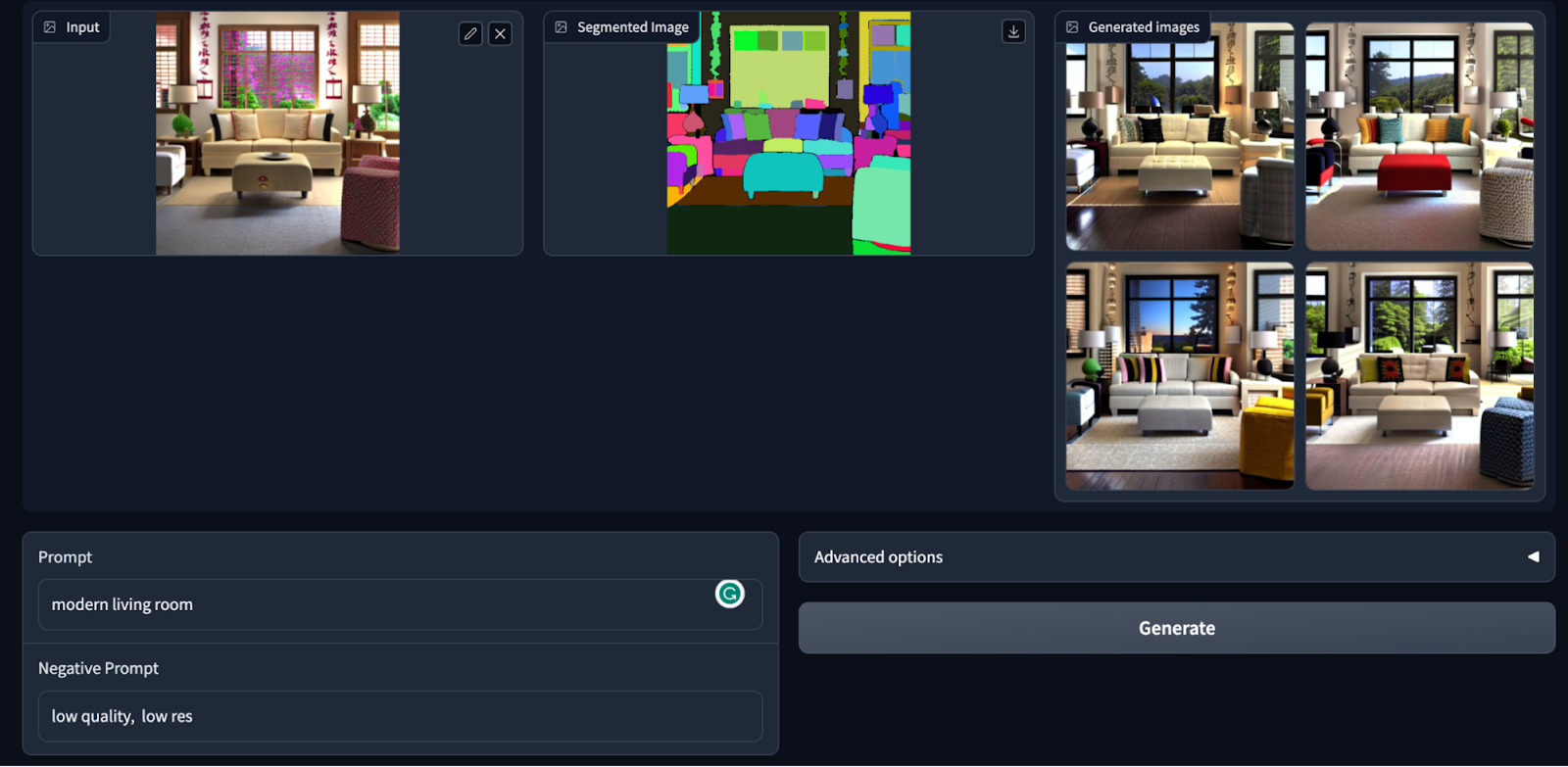
The project that won the sprint is ControlNet for interior design. The application can generate interior design based on a room image and prompt. It can also perform segmentation and generations, guided by image inpainting. See the application in inpainting mode below.

Screencap of a project using ControlNet for interior design

In addition to the projects above, many applications were built to enhance images, like this application to colorize grayscale images. You can check out the leaderboard to try all the projects.

Learning more about diffusion models

To kick-off the sprint, we organized a three-day series of talks by leading scientists and engineers from Google, Hugging Face, and the open source diffusion community. We'd recommend that anyone interested in learning more about diffusion models and generative AI take a look at the recorded sessions below!

Tim Salimans (Google Research) speaking on Discrete Diffusion Models
You can watch all the talks from the links below.

You can check out the sprint homepage to learn more.

Acknowledgements

We would like to thank Google Cloud for providing TPUs and storage to help make this great sprint happen, in particular Bertrand Rondepierre and Jonathan Caton for the hard work behind the scenes to get all of the Cloud TPUs allocated so participants had cutting-edge hardware to build on and an overall great experience. And also Andreas Steiner and Cristian Garcia for helping to answer questions in our Discord forum and for helping us make the training script example better. Their help is deeply appreciated.

By Merve Noyan and Sayak Paul – Hugging Face

Accelerate JAX models on Intel GPUs via PJRT

Thursday, June 1, 2023

We are excited to announce the first PJRT plugin implementation in Intel Extension for TensorFlow, which seamlessly runs JAX models on Intel® GPU. The PJRT API simplified the integration, which allowed the Intel GPU plugin to be developed separately and quickly integrated into JAX. This same PJRT implementation also enables initial Intel GPU support for TensorFlow and PyTorch models with XLA acceleration.

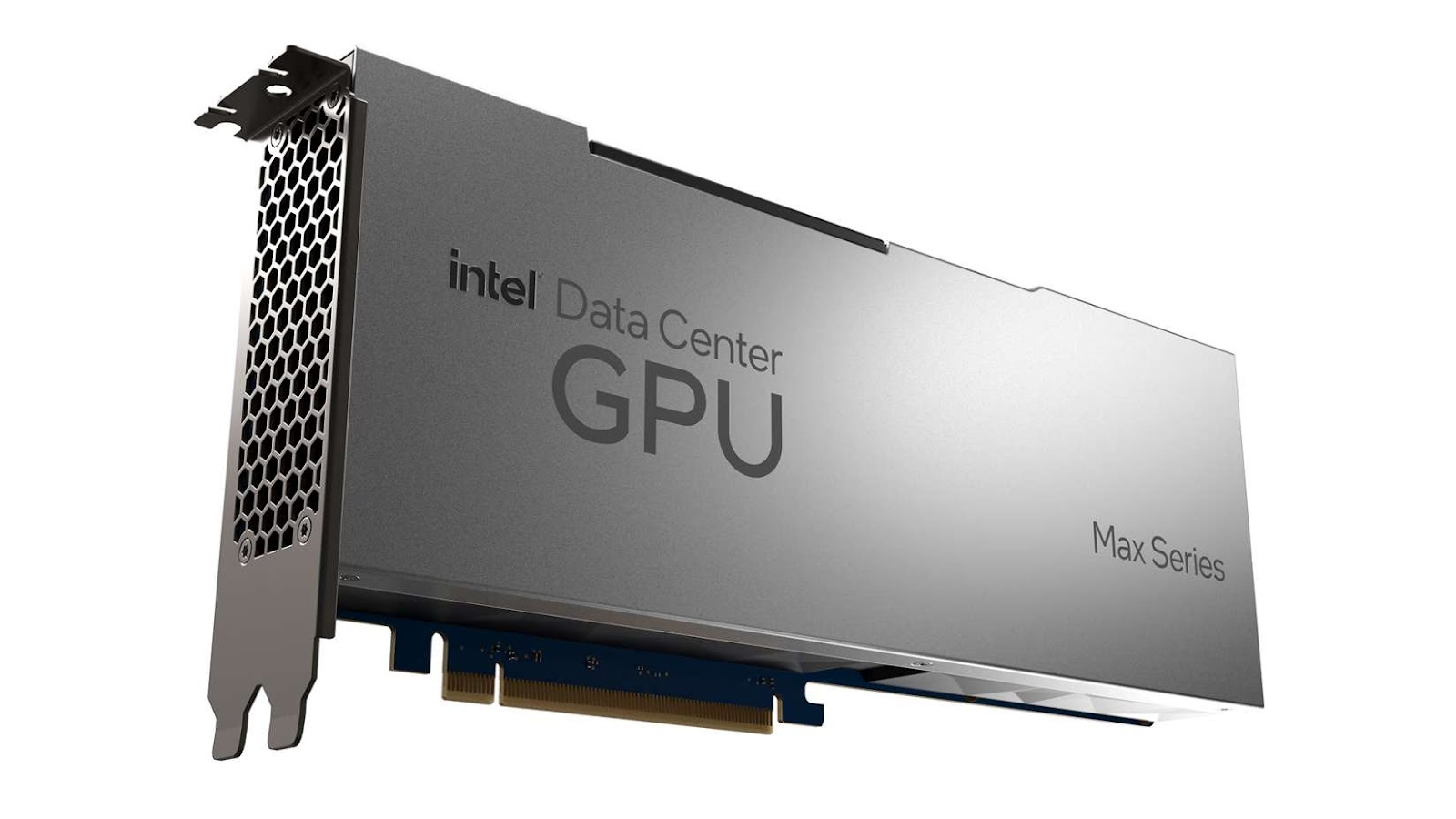
Image of the Intel
Figure 1. Intel Data Center GPU Max Series

With the shared vision that modular interfaces make integration easier and enable faster, independent development, Intel and Google collaborated in developing the TensorFlow PluggableDevice mechanism. This is the supported way to extend TensorFlow to new devices and allows hardware vendors to release separate plugin binaries. Intel has continued to work with Google to build modular interfaces for the XLA compiler and to develop the PJRT plugin to run JAX workloads on Intel GPUs.

JAX

JAX is an open source Python library designed for complex numerical computations on high-performance computing devices like GPUs and TPUs. It supports NumPy functions and provides automatic differentiation as well as a composable function transformation system to build and train neural networks.

JAX uses XLA as its compilation and execution backend to optimize and parallelize computations, particularly on AI hardware accelerators. When a JAX program is executed, the Python code is transformed into OpenXLA’s StableHLO operations, which are then passed to PJRT for compilation and execution. Underneath, the StableHLO operations are compiled into machine code by the XLA compiler, which can then be executed on the target hardware accelerator.

PJRT

PJRT (used in conjunction with OpenXLA’s StableHLO) provides a hardware- and framework-independent interface for compilers and runtimes (recent announcement). The PJRT interface supports the plugin from a new device backend. This interface provides a means for a straightforward integration of JAX into Intel's systems, and enables JAX workloads on Intel GPUs. Through PJRT integration with various AI frameworks, Intel’s GPU plugin can deliver hardware acceleration and oneAPI optimizations to a wider range of developers using Intel GPUs.

The PJRT API is a framework-independent API to allow upper level AI frameworks to compile and execute numeric computation represented in StableHLO on an AI hardware/accelerator. It has been integrated with popular AI frameworks including JAX, TensorFlow (via TF-XLA) and PyTorch (via PyTorch-XLA) which enables hardware vendors to provide one plugin for their new AI hardware and all these popular AI Frameworks will support it. It also provides low level primitives to enable efficient interaction with upper level AI frameworks including zero-copy buffer donation, light-weight dependency management, etc, which enables AI frameworks to best utilize hardware resources and achieve high-performance execution.

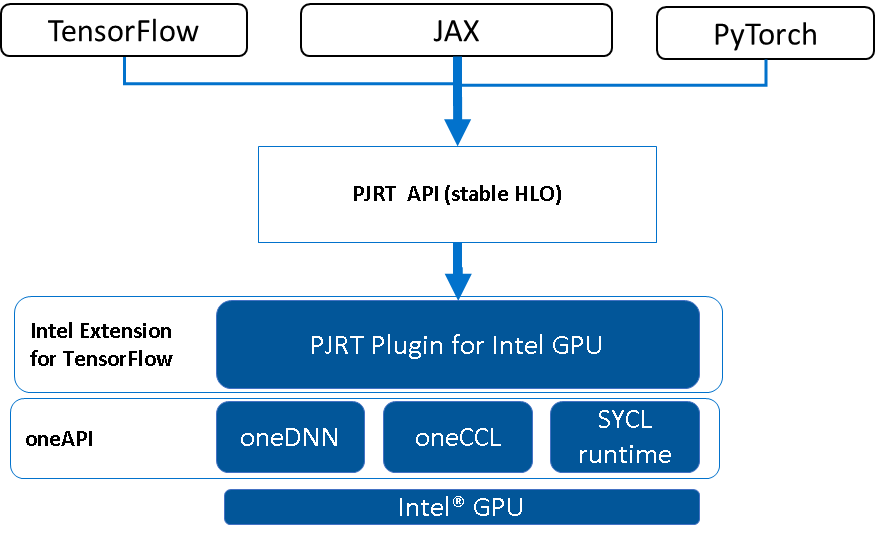
Image of the Intel
Figure 2. PJRT simplifies the integration of oneAPI on Intel GPU into AI Frameworks

PJRT Plugin for Intel GPU

The Intel GPU plugin implements the PJRT API by compiling StableHLO and dispatching the executable to Intel GPUs. The compilation is based on XLA implementation, adding target-specific passes for Intel GPUs and leveraging oneAPI performance libraries for acceleration. The device execution is supported using SYCL runtime. The Intel GPU Plugin also implements device registration, enumeration, and SPMD execution mode.

PJRT’s high-level runtime abstraction allows the plugin to develop its own low-level device management modules and use the advanced runtime features provided by the new device. For example, the Intel GPU plugin developed an out-of-order queue feature provided by SYCL runtime. Compared to fitting the plugin implementation to a low-level runtime interface, such as the stream executor C API used in PluggableDevice, implementing PJRT runtime interface is straightforward and efficient.

It’s simple to get started using the Intel GPU plugin to run a JAX program, including JAX-based frameworks like Flax and T5X. Just build the plugin (example documentation) then set the environment variable and dependent library paths. JAX automatically looks for the plugin library and loads it into the current process.

Below are example code snippets of running JAX on an Intel GPU.

$ export PJRT_NAMES_AND_LIBRARY_PATHS='xpu:Your_itex_library/libitex_xla_extension.so' $ export LD_LIBRARY_PATH=$LD_LIBRARY_PATH:Your_Python_site-packages/jaxlib $ python >>> import numpy as np >>> import jax >>> jax.local_devices() # PJRT Intel GPU plugin loaded [IntelXpuDevice(id=0, process_index=0), IntelXpuDevice(id=1, process_index=0)] >>> x = np.random.rand(2,2).astype(np.float32) >>> y = np.random.rand(2,2).astype(np.float32) >>> z = jax.numpy.add(x, y) # Runs on Intel XPU
This is the latest example of Intel AI tools and frameworks leveraging oneAPI software libraries to provide high performance on Intel GPU.

Future Work

This PJRT plugin for Intel GPUs has also been integrated into TensorFlow to run XLA supported ops in TensorFlow models. However, XLA has a smaller op set than TensorFlow. For many TensorFlow models in production, some parts of the model graph are executed with PJRT (XLA compatible) while other parts are executed with the classic TensorFlow runtime using TensorFlow OpKernel. This mixed execution model requires PJRT and TensorFlow OpKernel to work seamlessly with each other. The TensorFlow team has introduced the NextPluggableDevice API to enable this.

When using NextPluggableDevice API, PJRT manages all critical hardware states (e.g. allocator, stream manager, driver, etc) and NextPluggableDevice API allows hardware vendors to build new TensorFlow OpKernels that can access those hardware states via PJRT. PJRT and NextPluggableDevice API enable interoperability between classic TensorFlow runtime and XLA, allowing the XLA subgraph to produce a PJRT buffer and feed to TensorFlow and vice versa.

As a next step, Intel will continue working with Google to adopt the NextPluggableDevice API to implement non-XLA ops on Intel GPUs supporting all TensorFlow models.

Written in collaboration with Jianhui Li, Zhoulong Jiang, and Yiqiang Li from Intel.

By Jieying Luo, Chuanhao Zhuge, and Xiao Yu – Google

.