Showing posts with label GNOME. Show all posts
Showing posts with label GNOME. Show all posts
Geek Time with Karen Sandler
Tuesday, August 14, 2012
During LibrePlanet 2012, Jeremy Allison had some quality Geek Time with Karen Sandler, Executive Director of the GNOME Foundation. Some highlights from their chat can be found below.
Jeremy asks Karen to describe her role at the GNOME Foundation and what she does for free software. (0:40)
Karen chats about what makes GNOME different from other desktop software. (1:57)
Jeremy points out that Ubuntu uses its own separate interface, Unity, rather than using the GNOME 3 shell. Is there a chance Unity can be ‘unified’ with GNOME 3? (4:20)
Karen discusses the real challenge in the GNU Linux space, reaching new users. (5:05)
Jeremy asks Karen if GNOME collaborates on technology with the other Linux desktops like KDE? (6:15)
Karen answers the question what is GNOME doing to address the complete change in computing from desktop computing to tablets or phones in recent years? (8:05)
Karen describes what accessibility on a desktop means to her. (10:21)
Women in computing is an important topic for Karen so she discusses a couple of the programs she is involved in, including the GNOME Outreach Program for Women (12:38) and her advisory role in the Ada Initiative. (15:44)
Karen discusses her interest and passion for free software in medical devices. (17:20)
Jeremy inquires how Karen first became involved in the free software community and her path to Executive Director at the GNOME Foundation. (21:40)
A hearty thank you to Daniel Piccirillo for filming this interview.
By Stephanie Taylor, Open Source Programs
Desktop Summit 2011 visits Berlin
Monday, November 14, 2011
The Desktop Summit 2011 was held in Berlin, Germany, from 6-12 August 2011 and was the second joint conference of the GNOME and KDE communities. Almost 800 attendees gathered in Berlin to review progress, share ideas and work together on various free software projects relating to desktop and mobile user interfaces. While many participants were from Europe as expected, other contingents came from Brazil, India, the United States and beyond. The GNOME Foundation and KDE e.V. sponsored travel and accommodation costs for more than 80 attendees.
Desktop Summit organizers, mostly volunteers, worked for nearly a year to coordinate all the details that made the event successful. More than 50 volunteers pitched in to help the event run smoothly for the week. The collaborative spirit of Free and Open Source technology was an essential factor in how the group worked together.
There was a pre-registration event and two evening parties providing opportunities for people to spend time together without the stress of project deadlines. Other social activities included the traditional soccer and volleyball matches and as participants mostly concerned themselves with having fun (as well as a bit of beer drinking), it was not clear which of the KDE or GNOME teams won. There was an ice cream dessert gathering and unofficial curry cook-outs with food, drinks and conversation--both work and fun.
At the Summit, the City of Berlin announced the winners of its open source competition “Berlin – Made to Create”, a program promoting open source and open standards ideas and solutions. At the same session, the GNOME and KDE communities also announced their outstanding contributors.
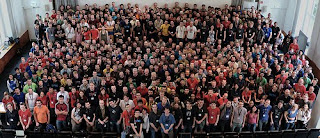
From Tuesday to Friday, 85 Birds of a Feather (BoFs) sessions and countless informal hacking sessions took place. Two hacking rooms and the hallways were full of people working on projects. BoFs ranged from small working groups to popular and multi-faceted projects to the introduction of new projects. The GObject Introspection Room shows the kinds of work undertaken at the Summit: a dedicated space with 12 to 20 people at any time, it ran the duration of the Summit, and was primarily focused on bug fixing GNOME API bindings. The KDE community also participated by working on bindings between GObject libraries and Qt/C++ and smoothing out other cross-desktop issues.
The KDE Release Team got together to talk about their strategy for Git versioning migration and the move to Frameworks 5. The BoF session was well attended, and included release team members and downstream packagers. In a short time, the team gathered feedback and came up with a plan for adding predictability to the release team's work and output, and for making the work within the team more effective and sustainable. Working remotely, this would have taken considerably longer and would not have achieved such good results.
The fifth Text Layout Summit was held concurrently with Desktop Summit 2011. At present, there are several font and text shaping technologies and no unified system library. As a result, complex text layout scripts such as Arabic or Myanmar are not well supported, and Western/European fonts often lack advanced text formatting capabilities. As FOSS applications are intended for use by all nationalities and languages, this is a serious shortcoming. Text Layout Summit 2011 made substantial progress toward a common approach, especially with Graphite, which is focused on the minority languages of the world.
The Desktop Summit is an important enabling event, making it possible for teams to learn, share and make substantial progress in their Free and Open Source projects. During the GNOME and KDE Annual General Meetings (AGMs), the respective projects recognized the achievements of members, made important announcements and reflected on the lessons learned over the past year. New Executive Director Karen Sandler led the GNOME AGM, with the recent release of GNOME 3 being a central topic. Many perspectives were contributed, including design, marketing, bug fixes and quality. The location of the 2012 GNOME Users And Developers European Conference (GUADEC) was revealed. With three impressive bids to host GUADEC, La Coruña, Spain, was chosen! The GNOME community looks forward to seeing its members next summer.
At the KDE e.V. AGM, President Cornelius Schumacher presented the work of the Board and KDE e.V. activities of the past 12 months. KDE e.V. organized or helped to organize several successful international conferences such as Akademy 2010 in Tampere, conf.kde.in in India, Camp KDE in San Francisco, and financially supported 21 contributor sprints. Cornelius Schumacher also explained the e.V.'s role in supporting and representing the KDE community in legal issues like domain handling, trademarks and similar areas.
Speaking for both organizations, Lydia Pintscher said, "We consider Desktop Summit 2011 in Berlin to have been a huge success for the collaboration among free software desktop communities. We learned a lot during the first Desktop Summit in Gran Canaria and were able to improve on many big and small things that made a real difference for the conference. We are looking forward to seeing the results of this work and to increased future collaboration."
By Carl Symons, William Carlson, and Stuart Jarvis
Desktop Summit organizers, mostly volunteers, worked for nearly a year to coordinate all the details that made the event successful. More than 50 volunteers pitched in to help the event run smoothly for the week. The collaborative spirit of Free and Open Source technology was an essential factor in how the group worked together.
There was a pre-registration event and two evening parties providing opportunities for people to spend time together without the stress of project deadlines. Other social activities included the traditional soccer and volleyball matches and as participants mostly concerned themselves with having fun (as well as a bit of beer drinking), it was not clear which of the KDE or GNOME teams won. There was an ice cream dessert gathering and unofficial curry cook-outs with food, drinks and conversation--both work and fun.
At the Summit, the City of Berlin announced the winners of its open source competition “Berlin – Made to Create”, a program promoting open source and open standards ideas and solutions. At the same session, the GNOME and KDE communities also announced their outstanding contributors.

From Tuesday to Friday, 85 Birds of a Feather (BoFs) sessions and countless informal hacking sessions took place. Two hacking rooms and the hallways were full of people working on projects. BoFs ranged from small working groups to popular and multi-faceted projects to the introduction of new projects. The GObject Introspection Room shows the kinds of work undertaken at the Summit: a dedicated space with 12 to 20 people at any time, it ran the duration of the Summit, and was primarily focused on bug fixing GNOME API bindings. The KDE community also participated by working on bindings between GObject libraries and Qt/C++ and smoothing out other cross-desktop issues.
The KDE Release Team got together to talk about their strategy for Git versioning migration and the move to Frameworks 5. The BoF session was well attended, and included release team members and downstream packagers. In a short time, the team gathered feedback and came up with a plan for adding predictability to the release team's work and output, and for making the work within the team more effective and sustainable. Working remotely, this would have taken considerably longer and would not have achieved such good results.
The fifth Text Layout Summit was held concurrently with Desktop Summit 2011. At present, there are several font and text shaping technologies and no unified system library. As a result, complex text layout scripts such as Arabic or Myanmar are not well supported, and Western/European fonts often lack advanced text formatting capabilities. As FOSS applications are intended for use by all nationalities and languages, this is a serious shortcoming. Text Layout Summit 2011 made substantial progress toward a common approach, especially with Graphite, which is focused on the minority languages of the world.
The Desktop Summit is an important enabling event, making it possible for teams to learn, share and make substantial progress in their Free and Open Source projects. During the GNOME and KDE Annual General Meetings (AGMs), the respective projects recognized the achievements of members, made important announcements and reflected on the lessons learned over the past year. New Executive Director Karen Sandler led the GNOME AGM, with the recent release of GNOME 3 being a central topic. Many perspectives were contributed, including design, marketing, bug fixes and quality. The location of the 2012 GNOME Users And Developers European Conference (GUADEC) was revealed. With three impressive bids to host GUADEC, La Coruña, Spain, was chosen! The GNOME community looks forward to seeing its members next summer.
At the KDE e.V. AGM, President Cornelius Schumacher presented the work of the Board and KDE e.V. activities of the past 12 months. KDE e.V. organized or helped to organize several successful international conferences such as Akademy 2010 in Tampere, conf.kde.in in India, Camp KDE in San Francisco, and financially supported 21 contributor sprints. Cornelius Schumacher also explained the e.V.'s role in supporting and representing the KDE community in legal issues like domain handling, trademarks and similar areas.
Speaking for both organizations, Lydia Pintscher said, "We consider Desktop Summit 2011 in Berlin to have been a huge success for the collaboration among free software desktop communities. We learned a lot during the first Desktop Summit in Gran Canaria and were able to improve on many big and small things that made a real difference for the conference. We are looking forward to seeing the results of this work and to increased future collaboration."
By Carl Symons, William Carlson, and Stuart Jarvis
GNOME roams to Montreal
Tuesday, November 1, 2011

The Montreal Summit 2011 turned out to be a very fun and productive gathering earlier this month of GNOME hackers and developers. With the 3.2 release behind us, there was a lot of discussion about the state of GNOME and its path going forward, reflected both in the technical and non-technical sessions that were held.
The group present went through all of the features for GNOME 3.3/3.4 and discussed kicking off the 3.3 cycle which tied in nicely with discussions currently underway on the mailing lists. There were presentations on Baserock by Lars Wirzenius, jhbuild by Colin Walters, and one on the application menu with canonical contributing a good chunk of code toward an improved application menu. A number of sessions talked about GNOME strategy, posing questions such as what are we building, who is it for and how do we get there. There were talks about building an OS, and the various complications that inevitably come up when you put together a system out of many evolving pieces. And Marina Zhurakhinskaya led a talk on how to improve and maximize GNOME’s participation in the Google Summer of Code program.
So much was going on that even though the event wasn’t huge there were many people there that I never even got the chance to talk to and I’m sure there was a lot accomplished that I don’t even know about (for example, Olivier Crete tells me that he made a fix to again allow the use of the free Theora codec for VoIP calls in Empathy). There were also some discussions around how quite a few of this year’s participants were involved in the GNOME Women's Outreach Program.
Many thanks to the sponsors who made this event possible!
By Karen Sandler, GNOME Foundation’s Executive Director
Interviews from GUADEC, Part 5
Friday, September 17, 2010
This week we have the last video in Jeremy Allison’s series of interviews from his trip to GUADEC, the GNOME conference. In this video, he talks to Michael Meeks, early GNOME hacker and OpenOffice.org developer. Jeremy and Michael talk about collaboration, malware, and how Michael started his involvement with GNOME. For those who are new to open source, Michael gives tips for those who want to get involved in the GNOME community, developer and non-developer alike. For non-developers, Jeremy also gives translations of geek-speak throughout.
If you missed the earlier videos, you can watch all of Jeremy’s GUADEC interviews together in a playlist. Even though this is the last in the GUADEC series, don’t worry, more interviews are coming up soon because Jeremy just returned from LinuxCon Sao Paulo, Brazil, where he was able to get some amazing interviews. Stay tuned!
By Ellen Ko, Open Source Team
Interviews from GUADEC, Part 4
Friday, September 10, 2010
Stormy Peters is the Executive Director of the GNOME Foundation, and when Jeremy Allison from the Google Open Source Programs Office ran into her at GUADEC, he was eager to talk to her about the direction that GNOME is heading. In the video above, Stormy and Jeremy discuss release schedules, GNOME 3, and hackfests. Enjoy!
By Ellen Ko, Open Source Team
Interviews from GUADEC, Part 2
Friday, August 27, 2010
At many open source conferences, discussions about diversity come up and there is a lot of talk about how to make the open source community more inclusive and welcoming. While the Open Source Programs Office’s Jeremy Allison was at GUADEC, he had a chance to talk to someone who is actively doing something to get more women involved in free software. Marina Zhurakhinskaya, GNOME Shell developer and Senior Software Engineer at Red Hat, is an organizer of the GNOME Outreach Program for Women and she spoke to Jeremy on camera about the program’s activities.
One of the projects that the program has completed was a mentoring program similar to Google Summer of Code, which provided six women with mentors and stipends to help stimulate open source development. They plan to repeat their success again this year with the 2010 GNOME Outreach Program for Women, which will run from mid-December through mid-March to coincide with the Southern Hemisphere’s school break. If you’re interested in participating, take a look at the list of participating projects to see what sparks your interest, check out the mailing list, or help spread the word to anyone who you think should apply!
Thanks to Fabian Scherschel of Sixgun Productions for operating the camera.
By Ellen Ko, Open Source Team
GNOME Usability Hackfest
Wednesday, March 24, 2010
 Google recently sponsored the GNOME Usability Hackfest, which took place in London. With over 30 GNOME design and usability experts attending on some days, it was an unusually large, exciting and dynamic event. As GNOME 3.0 is just around the corner, people took advantage of the opportunity to build bridges within the GNOME usability community, and re-think the desktop paradigm.
Highlights for me included:
- Talking accessibility with Willie Walker
- Charline Poirier's Empathy Usability Report and Icon Usability Study
- Card sorting exercises to get a better understanding of how to organize applications and settings
- Usability improvements for GTK+.
- Discussions about how to improve Nautilus usability
In the last few days at the event, I spent a fair amount of time cleaning up the GNOME Usability Project Wiki so it is more clear and straightforward. I also did a lot of coordination with the Dev8D conference organizers to arrange for GNOME speakers at their event, and made arrangements for Antonio Roberts from the Dev8D community to attend the GNOME Usability Hackfest and participate on Thursday the 25th.
The GNOME Usability team has posted a great deal of blog posts, articles, and photos highlights about the work done at this hackfest and as more attendees post their notes, they will be updated onto the GNOME Planet blog aggregator. You can see my blog for more photos and a full report on the event. Many thanks to Google for sponsoring this event.
GNOME.Asia Summit News
Monday, February 1, 2010

The GNOME.Asia Summit 2009 was held at Quang Trung Software City in Ho Chi Minh City (Saigon), Vietnam this past November. The event attracted more than 1,000 participants from 14 countries including Cambodia, China, France, Germany, Hong Kong, Singapore, Taiwan and the United States. 79 speakers — 34 from outside of Vietnam — held 109 talks, presentations and panels, and the slides are available for download. The event was supported by 138 volunteers, nearly 100 of whom were women. The combined number of all participants was 1465, with 60% women attendees. The organizing committee is very proud that our conference was such a welcoming event for women in the Open Source community.
GNOME.Asia 2009 was the first community event of its kind in Vietnam. The engagement of large, multinational companies like our sponsor Google, as well as many local companies, reflects the increasing importance of Free and Open Source solutions for businesses in Asia. The event was exceptionally well-covered in the Vietnamese media; all major media outlets, including three TV stations, covered the event.
In addition to hacker space for GNOME core projects, the summit offered meet-up opportunities for related Free and Open Source projects. 255 people participated in our Linux course, which was organized in cooperation with Ubuntu Vietnam. A Saigon Mapping Party was organized by the OpenStreetMap Community together with local companies. OpenOffice and OpenSolaris were community partners. Local groups including Saigonlug, Java Vietnam, Vithon (Python), Mekong Open Source Club (MOSS), LXDE and BKIT supported the organization and set-up of the event. Education partners included Saigontech and the University of Pedagogy.
Looking Forward to the 2010 Summit
The work for GNOME.Asia 2010 is starting already. The call for a new location will be published in the upcoming weeks. A good potential spot is Taiwan, where there is interest and where the summit could be co-hosted with local events. Singapore could be a good location for a future event. Locally one of the major goals after the GNOME.Asia Summit is to use the momentum to foster development for the GNOME project, as well as Free and Open Source software in general. Our post-event goals include creating meeting and education labs that can function as hackerspaces for local groups to promote FOSS and GNOME. We hope that groups interested in helping coordinate GNOME.Asia will answer the call for location and volunteers when it is published, so keep an eye on our website for details.
Crossing the Desktops in Gran Canaria
Monday, July 20, 2009
The Gran Canaria Desktop Summit ended just a few days ago, and now everyone is back to work sun-tanned and/or sun-burnt, but loaded with new ideas. The idea behind this summit was to organize GUADEC and aKademy, the yearly GNOME and KDE conferences, on the same spot so that developers from the two communities could get together and more freely exchange ideas.

The series of keynotes that opened the event was particularly interesting with, among others, Robert Lefkowitz sailing between computers and philosophy and, of course, Richard Stallman dressed up as St. IGNUcius.

We were given the chance to darken our hacker-pale skin a tiny bit thanks to the green towel that was offered to each participant. GNOME and KDE hackers alike delivered many keynotes and talks, especially cross-desktop talks to help explore and overcome problems encountered in both projects). Hacking and chatting on the beach was another popular conference activity.

All in all, one always comes back from such an event with starry eyes and a dreamy mind about the exciting (very near) future of the two desktops, and their tightened collaboration. Stay tuned for a lot of hot things happening soon in a desktop near you, and let's hope that next year's event will bring us the same amount of excitement and sunshine!

The series of keynotes that opened the event was particularly interesting with, among others, Robert Lefkowitz sailing between computers and philosophy and, of course, Richard Stallman dressed up as St. IGNUcius.

We were given the chance to darken our hacker-pale skin a tiny bit thanks to the green towel that was offered to each participant. GNOME and KDE hackers alike delivered many keynotes and talks, especially cross-desktop talks to help explore and overcome problems encountered in both projects). Hacking and chatting on the beach was another popular conference activity.

All in all, one always comes back from such an event with starry eyes and a dreamy mind about the exciting (very near) future of the two desktops, and their tightened collaboration. Stay tuned for a lot of hot things happening soon in a desktop near you, and let's hope that next year's event will bring us the same amount of excitement and sunshine!
GNOME's Runner Ups
Thursday, April 17, 2008
The good news from the Google Highly Open Participation Contest (GHOP) keeps on coming. This week, Andre Klapper, one of GNOME's mentors for GHOP, wrote in to tell us about three additional outstanding contributors.
Andre shares this note about GNOME's runner ups:
David Turner
David took on a variety of tasks. He warmed up by working on some of GNOME's “choose the bugs yourself” tasks (fixing twelve mnemonic bugs and testing five patches from GNOME’s bugzilla) just to dive into the code bases of empathy (providing support for removing groups) and gThumb (preparing to remove the libexif library ). He also vastly improved the scrolling support in Evince. In addition to this, David updated the JHBuild moduleset schemas and the (now new and shiny) manual itself.
David already had open source development experience, as the developer of tuxcast, a command-line Linux podcatcher.
Natan Yellin
Natan wrote an article on GConf for the GNOME Journal (not yet released). He provided Drag-and-drop support for the Online Desktop file widget and a mail widget for the Online Desktop sidebar, fixed a Deskbar-Applet bug and also modified gThumb’s metadata handling and enhancing gThumb’s script definitions. Natan is full of ideas and provided own proposals for potential tasks. He is especially interested in AWN (a dock-like bar) and currently thinks about creating a universal applets framework for GNOME.
Philipp Kerling
Philipp added an LCOV code coverage suite to Pango and GTK+ to measure code coverage. He also contributed code to the GNOME online desktop module by providing an embedded workspace switcher widget and popouts for the Online Desktop file widget. He removed old icons from the gnome-desktop module that are now shipped in gnome-icon-theme and fixed four bugs in gnome-build. Philipp has also contributed to GNOME’s German translation team.
Congratulations to David, Natan and Philipp, as well as all of GNOME's GHOP students for their many contributions to the project!
After the Summer, the Code Lives On
Friday, February 22, 2008
The first time I wrote a piece of code with the intention of making it open source was, like many other people, when I was still a student. As a project for a computer vision class, a classmate and I wrote a plugin for The GIMP to smart-generate textures.
Since this was just a project for college, I wasn't expecting very much from it except good marks, which we got. However, I was pleasantly surprised to receive a lot of kind feedback from the GNOME community, and especially from happy users. I then realized that the community was one of the most important parts of the open source world, probably as important as the code itself. I certainly wouldn't have bothered to maintain and enhance this software, releasing a version 2.0 a few months later, if I didn't get all this feedback showing me that my code was actually useful to people out there.
So when Google announced their first "Summer of Code" program in 2005, I thought I'd give it a try, even though the competition looked pretty tough. I was, again, pleasantly surprised to be selected to work for Ubuntu.
This time I wasn't just coding alone or with a classmate - things got international! I spent a lot of time on IRC discussing my project, seeking advice from developers all around the world: French, German, Australian, American, Mexican, you name it, everyone was hanging around in the IRC channels. They were always kind and patient with my newbie questions, especially my mentor for this program, Sebastien Bacher. Interacting with the community was one of the best parts of this experience, along with writing code and designing user interfaces that would be used by everyone running Ubuntu. If you hate that dialog to add an applet to your panel, or the Ubuntu logout dialog, you now know whom to rant at!
I had so much fun that when Google announced they would have the same program in 2006, I applied again, and was pleasantly surprised yet again to be selected to work with the OLPC project. This time my mentor was none other than Federico Mena Quintero. Things were getting serious.
I decided to go to GUADEC 2006, GNOME's annual conference, so that I could meet Federico, and also Sebastien whom I hadn't had the chance to meet yet. It was really interesting to see all those familiar IRC nicknames suddenly transform into actual people and be able to communicate with them in ways more sophisticated than "/me pings seb128"! Here's a short video (about 10 minutes) explaining what I did during these two summers.
GUADEC also allowed me to discover a bit more about Google and find out that it looked like a really great company to work for... and here I am now, a few months later, working for Google! I must say it is as great as I had imagined. And even though I'm obviously busy enough with my main project, GMail, I have chosen to work on GNOME as my "20%" project. I thought it was the best thing to do given how much I have learned from Sebastien, Federico, and everyone in the open source community. See all of you soon on IRC!