opensource.google.com

Menu
Showing posts with label Explore. Show all posts

The Kubernetes ecosystem is a candy store

Monday, June 3, 2024


For the 10th anniversary of Kubernetes, I wanted to look at the ecosystem we created together.

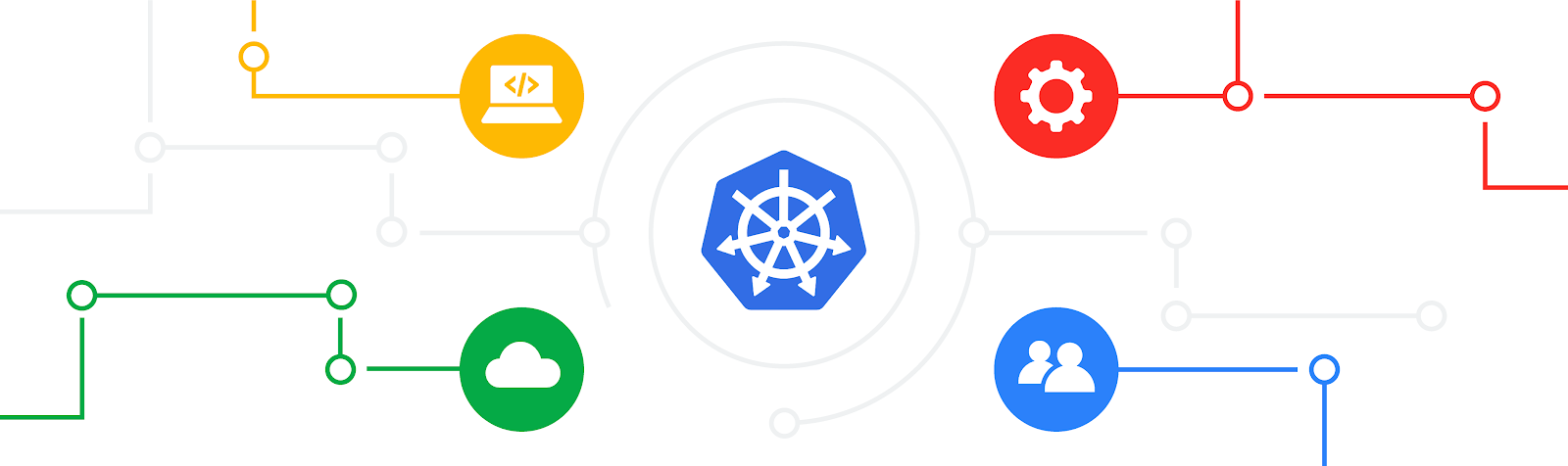
I recently wrote about the pervasiveness and magnitude of the Kubernetes and CNCF ecosystem. This was the result of a deliberate flywheel. This is a diagram I used several years ago:

Flywheel diagram of Kubernetes and CNCF ecosystem

Because Kubernetes runs on public clouds, private clouds, on the edge, etc., it is attractive to developers and vendors to build solutions targeting its users. Most tools built for Kubernetes or integrated with Kubernetes can work across all those environments, whereas integrating directly with cloud providers directly entails individual work for each one. Thus, Kubernetes created a large addressable market with a comparatively lower cost to build.

We also deliberately encouraged open source contribution, to Kubernetes and to other projects. Many tools in the ecosystem, not just those in CNCF, are open source. This includes many tools built by Kubernetes users and tools built by vendors but were too small to be products, as well as those intended to be the cores of products. Developers built and/or wrote about solutions to problems they experienced or saw, and shared them with the community. This made Kubernetes more usable and more visible, which likely attracted more users.

Today, the result is that if you need a tool, extension, or off-the-shelf component for pretty much anything, you can probably find one compatible with Kubernetes rather than having to build it yourself, and it’s more likely that you can find one that works out of the box with Kubernetes than for your cloud provider. And often there are several options to choose from. I’ll just mention a few. Also, I want to give a shout out to Kubetools, which has a great list of Kubernetes tools that helped me discover a few new ones.

For example, if you’re an application developer whose application runs on Kubernetes, you can build and deploy with Skaffold, test it on Kubernetes locally with Minikube, or connect to Kubernetes remotely with Telepresence, or sync to a preview environment with Gitpod or Okteto. When you need to debug multiple instances, you can use kubetail to view the logs in real time.

To deploy to production, you can use GitOps tools like FluxCD, ArgoCD, or Google Cloud’s Config Sync. You can perform database migrations with Schemahero. To aggregate logs from your production deployments, you can use fluentbit. To monitor them, you have your pick of observability tools, including Prometheus, which was inspired by Google’s Borgmon tool similar to how Kubernetes was inspired by Borg, and which was the 2nd project accepted into the CNCF.

If your application needs to receive traffic from the Internet, you can use one of the many Ingress controllers or Gateway implementations to configure HTTPS routing, and cert-manager to obtain and renew the certificates. For mutual TLS and advanced routing, you can use a service mesh like Istio, and take advantage of it for progressive delivery using tools like Flagger.

If you have a more specialized type of workload to run, you can run event-driven workloads using Knative, batch workloads using Kueue, ML workflows using Kubeflow, and Kafka using Strimzi.

If you’re responsible for operating Kubernetes workloads, to monitor costs, there’s kubecost. To enforce policy constraints, there’s OPA Gatekeeper and Kyverno. For disaster recovery, you can use Velero. To debug permissions issues, there are RBAC tools. And, of course, there are AI-powered assistants.

You can manage infrastructure using Kubernetes, such as using Config Connector or Crossplane, so you don’t need to learn a different syntax and toolchain to do that.

There are tools with a retro experience like K9s and Ktop, fun tools like xlskubectl, and tools that are both retro and fun like Kubeinvaders.

If this makes you interested in migrating to Kubernetes, you can use a tool like move2kube or kompose.

This just scratched the surface of the great tools available for Kubernetes. I view the ecosystem as more of a candy store than as a hellscape. It can take time to discover, learn, and test these tools, but overall I believe they make the Kubernetes ecosystem more productive. To develop any one of these tools yourself would require a significant time investment.

I expect new tools to continue to emerge as the use cases for Kubernetes evolve and expand. I can’t wait to see what people come up with.

By Brian Grant, Distinguished Engineer, Google Cloud Developer Experience

The Power of Open Source

Thursday, April 11, 2024


At the day 1 keynote of Open Source Summit North America, Timothy Jordan, Director of Developer Relations and Open Source at Google, will talk about the landscape of open source and AI, the importance of a responsible approach, and the transformative impact of community collaboration. In anticipation of this talk, let’s break down the AI open source ecosystem, and how Google approaches it.

Google believes in the power of open technology to drive innovation and benefit everyone. It fosters creativity and collaboration, while ensuring technology access for developers and allowing customization to fit unique use cases. Open source licenses give developers full creative autonomy without restriction. It is this ecosystem of open source and open technology, shaped by ML frameworks like TensorFlow, Keras, and JAX, that has enabled so many incredible advances in AI in recent years.

The open source community has been in discussion on how to apply the Open Source Definition to carry forward the open principles of the OSD while addressing concepts like derived work and author attribution in AI. During Timothy’s keynote, he’ll speak to his own philosophy on Open Source and AI, and share how his assumptions about how we apply open source to AI have evolved. The immediate availability of AI models, powered by the open source ecosystem of ML frameworks, means it’s more important than ever that we establish a shared definition for open source and AI.

While that definition is in development, at Google we’re using precise language to describe our openly available models like Gemma. The definition and license is only one part of this open ML/AI future; advancements in safety tooling, policies, and developer knowledge are all part of creating a responsible and open future for AI. Those advancements are all fueled by a dedication to collaboration. Whether sharing innovations and improvements with the community, or having conversations with policymakers and open source leaders, collaboration is key to a responsible approach to AI in the open ecosystem. AI can only be safe and responsible if everyone’s experiences and perspectives are brought to the forefront as it’s built.

To demonstrate how open source has made AI readily available, Timothy will also take the audience through a “low code” demo of how to run large language models in-browser for web applications. Using MediaPipe, the LLM Inference API, and Gemma, users can quickly add genAI capabilities like document summarization and text generation.

Join us at Open Source Summit North America for this keynote, and visit opensource.google to learn more.

By the Google Open Source team

Open source PDKs joining the Linux Foundation’s CHIPS Alliance

Wednesday, November 8, 2023

In November 2020, we launched our Open Source MPW Shuttle Program to make it easier for researchers and developers to build custom silicon and to enable a thriving ecosystem around open source hardware. Working with our partner, SkyWater Technology, we released the first foundry-supported open source process design kit (PDK) for their 130nm mixed-signal CMOS technology (SKY130), then welcomed GlobalFoundries as a partner with the release of an open source PDK for their 180nm MCU process (GF180MCU).

Then, to give researchers and developers a way to validate and prove their designs made with the PDKs, we partnered with Efabless to fund a series of no-cost manufacturing shuttles for open source designs. In support of this program, Efabless released an end-to-end RTL to GDS design stack called OpenLane that is open source, freely available, and fully supported by their manufacturing platform. OpenLane is now being maintained as part of the OpenROAD Project. When combined with open source PDKs, a design’s verification results can now be freely shared and easily replicated by other researchers and developers, which has enabled a new collaborative model to evaluate and iterate on ideas.

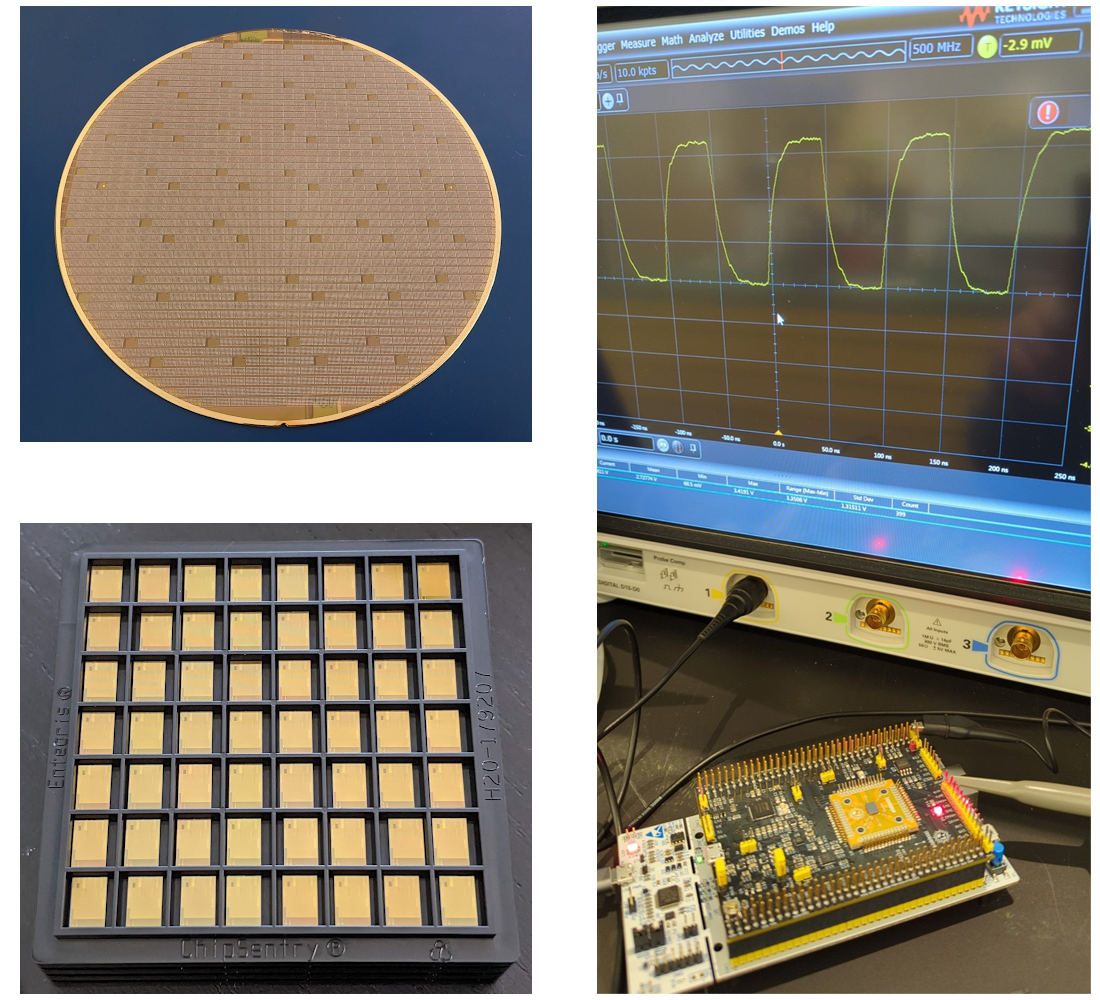
Pictures of a full wafer from the first SKY130 shuttle, a tray of bare dies, and a project bring-up from SKY130 MPW-2.

Results

The Open Source MPW Shuttle Program has been a success and we’re excited by the growth we’ve seen in this ecosystem. Since its inception, the program has launched eight shuttle runs on SKY130 and an initial test run on GF180MCU, the last of which are being packaged now. With 40 slots per shuttle, we’ve manufactured 360 designs out of over 600 submissions from 19 countries around the world.Graph showing number of designs submitted to Open Source MPW shuttles across versions 1 through 8

The program has also fostered collaboration between the open source community and Google. We’ve learned valuable lessons from designers who participated in the program giving feedback and filing hundreds of bugs and pull requests. These have helped to improve each successive run and to make the platforms and tools more feature-complete.

Elsewhere in the ecosystem, we’re excited by the release of new open source PDKs from foundries like the 130nm BiCMOS process from IHP, the SOI-CMOS PDK from Minimal Fab, and also by the publication of new semiconductor research using open source PDKs. Multiple universities have incorporated open source PDKs into their curriculum, and last year, NIST adopted the SKY130 PDK to migrate their existing planarized wafer designs for nanotechnology research.

Announcing GF180MCU MPW-1

We’ve just launched a new MPW-1 shuttle for GF180MCU in our partnership with Efabless. Submissions will be accepted until December 11th, targeting delivery in early 2024.

Graph showing number of designs submitted to Open Source MPW shuttles across versions 1 through 8

Next Steps

The open source silicon ecosystem is continuing to grow and evolve. After GF180 MPW-1 concludes, the open source SKY130 and GF180MCU PDKs will be joining the Linux Foundation’s CHIPS Alliance under a new working group to foster continued open source PDK development, and we expect future PDK releases will join as well. This will help with the transition to a broader governance model that enables more participation by industry, academia and the community, opening the possibility for larger shuttle programs with multiple sponsors as the ecosystem continues to grow.

Low-cost manufacturing options will continue to be available through this transition, both through commercial shuttle offerings like Efabless’ ChipIgnite program and also through educational efforts like TinyTapeout.

Thank you

Lastly, we’d like to thank the open source community. Your feedback has been invaluable to the success so far, and has helped to improve the tools and documentation to be more user-friendly. We have also seen contributions from the community in the form of hundreds of new and fully manufacturable designs, which have helped to expand the range and capabilities of open source hardware available to the community. We look forward to continuing partnerships to build a thriving ecosystem around open source silicon.

By Aaron Cunningham – Technical Program Manager, Core Hardware Tools

Finding Stability in Open Source Work

Wednesday, October 25, 2023

At Google, open source is at the core of our infrastructure, processes, and culture. For the last 19 years, Google’s Open Source Programs Office (OSPO) has enabled our organization to support open source ecosystems through funding, training, mentorship and direct contribution. Every year for the last 5 years, roughly 10% of our workforce has contributed to open source projects as part of their work as well as in their personal time. We’re focused on investing in and protecting open source communities and infrastructure, as well as expanding access to open source opportunities around the world. Every day we seek to promote open and connected ecosystems as the foundation of technological advancement.

For the last four years, researchers in Google's Open Source Programs Office (OSPO) have analyzed our open source contribution activity annually to identify trends and changes in behavior. The goal of this effort has been to increase transparency and accountability across all of the communities we engage with, as well as provide feedback indicators for Alphabet’s internal tools, processes, and policies. In this iteration, our 2022 open source contribution metrics were remarkably consistent with what we found in 2021, which gives us confidence that what we're measuring is a good representation of open source behavior, especially after the extreme outlier year of 2020.


Security remains a priority

At Alphabet, open source software remains a critical component of our infrastructure, products, and services and we continue to rely on the health and availability of open source projects. Through internal efforts and collaboration with industry-led efforts such as OpenSSF, Alphabet is committed to bolstering the security posture of projects, users, and developers of open source software.

In 2021, Google began funding two Linux Foundation contractors to focus exclusively on security, and in 2022 we've continued to sponsor their work to eliminate fragile C language features and APIs in the kernel. We also continue to support the Rust-in-Linux project, with the goal of improving memory safety, strengthening APIs, and reducing the number of bugs overall in the project. In late 2022, Rust infrastructure support landed in the upstream kernel.

The deps.dev project released a public BigQuery dataset, allowing anyone to explore and analyze the dependencies, advisories, ownership, license, and other metadata of open source packages across supported ecosystems, and explore how this metadata has changed over time.

In 2022 we announced:

  • The OSV-Scanner, a free tool enabling open source developers and users to identify and remediate known vulnerabilities in their project's OSS dependencies. The OSV-Scanner provides a supported frontend to the OSV database which connects a project’s list of dependencies with the vulnerabilities that affect them.
  • The GOSST Upstream Team, a dedicated staff of Google open source security engineers who spend 100% of their time working closely with upstream maintainers to improve the security of critical open source projects.
  • Graph for Understanding Artifact Composition (GUAC) which aggregates software security metadata into a high fidelity graph database–normalizing entity identities and mapping standard relationships between them.

Our contributions continue to scale with our growing workforce

In 2022, roughly 10% of Alphabet's full-time workforce contributed to open source projects hosted on GitHub or Git-on-Borg - our internal production Git service (more details below). This percentage has remained roughly consistent over the last five years, indicating that our open source contribution has continued to scale with the growth of Alphabet. Similar to last year, FTEs represented over 95% of our open source workers, while the remainder includes vendors, independent contractors, temporary staff, and interns who contributed to open source projects during their tenure at Alphabet.

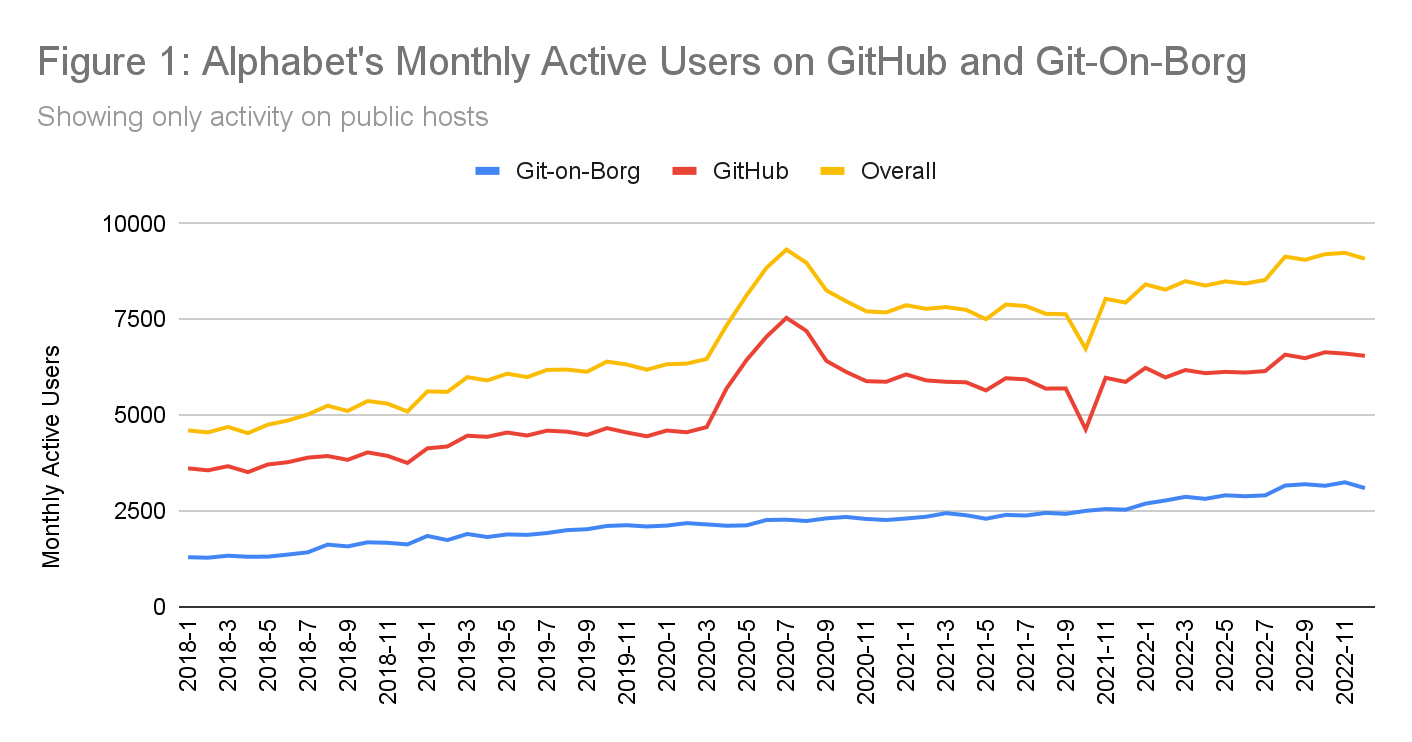
As open source work is core to our ongoing operations, we continue to track engagement over time, helping to compare continuous and sporadic participation. On average, over 45% of our active* contributing population for the year logged an activity on GitHub or Git-on-Borg in an average month. (see Figure 1)
This chart shows Alphabet's monthly active users on GitHub and Git-on-Borg. Over the last five years, the trajectory of monthly active users has continued to increase on both GitHub and Git-on-Borg by more than 15% year over year per month

Our portfolio of projects remains active

We estimate that more than 2000 projects that originated from Alphabet teams and employees were still active* (not archived). To make this estimate, we chose a broad and variable definition of an open source project, including developer tools, utilities, languages, frameworks, libraries, demos, sample code, models, raw data, designs, and more.

Project counts should not be confused with repositories as projects can include many repositories. Within Alphabet, we maintain over 7500 public repositories on GitHub and 1600 public repositories on Git-on-Borg. Our total repositories under management have reduced over time with the enforcement of a new archiving policy that flags repositories for archiving based on activity levels and owner feedback. Most of these repositories are open to outside contribution: more than 500,000 unique GitHub accounts not affiliated with Alphabet workers contributed to Alphabet projects in 2022.

The majority of our open source work happens outside of Alphabet organizations

The majority of repositories we work on are outside of Alphabet organizations: Over the last five years, more than 70% of non-personal GitHub repositories Alphabet contributors interacted with were outside of Google-managed organizations. We updated the methodology behind this metric since our last edition to filter out forks created in the pull request workflow. The top projects (by unique contributors at Alphabet) include Google-initiated projects such as Kuberenetes, Apache Beam, and gRPC as well as community-led projects such as LLVM, Envoy, and Rust.


We continue to invest in the sustainability of open source ecosystems

The mission of the Google Open Source Programs Office remains the same: we sponsor, create, and invest in projects and programs that enable everyone to join and contribute to the global open source ecosystem. In 2022, OSPO provided $5.7M in membership fees and sponsorship funding to 60 key open source projects and organizations. This funding was in addition to our established annual programs:

  • In its 18th year, Google Summer of Code enabled more than 1000 individuals to contribute to more than 150 organizations. Over the lifetime of this program, more than 19,000 individuals from 112 countries have contributed to more than 800 open source organizations across the globe.
  • In its fourth year, Google Season of Docs provided direct grants to 30 open source projects to hire more than 50 technical writers to improve open source project documentation, and published its second case study report highlighting useful open source documentation metrics. More than half of the documentation created in the 2022 program were how-tos, tutorials, and reference documentation; projects primarily wanted to add documentation for missing use cases and fix disorganized documentation.
  • Since 2011, the Google Open Source Peer Bonus Program has awarded bonuses for open source contributions to members of our extended community. In 2022 more than 300 contributors received awards, working in over 40 countries on more than 200 open source projects.

Our open source work will continue to grow and evolve to support the changing needs of our communities. Thank you to our colleagues and community members who continue to dedicate their personal and professional time supporting the open source ecosystem. Follow our work at opensource.google.

By Sophia Vargas – Researcher, Google Open Source Programs Office


About this data:

This report features metrics provided by many teams and programs across Alphabet. In regards to the code and code-adjacent activities data, we wanted to share more details about the derivation of those metrics.

2022 updates: This year, we decided to remove event counts as it is increasingly difficult to differentiate automated activities from human-centered work. Even after filtering out non-human accounts, we couldn’t correlate these events to employee time spent on open source projects, and so we reduced our reporting to focus on our population and scope of effort.

  • Data sources: These data represent activities on repositories hosted on GitHub and our internal production Git service Git-on-Borg. These sources represent a subset of open source activity currently tracked by Google OSPO.
    • GitHub: We continue to use GitHub Archive as the primary source for GitHub data, which is available as a public dataset on BigQuery. Alphabet activity within GitHub is identified by self-registered accounts, which we estimate underreports actual activity.
    • Git-on-Borg: This is our primary platform for internal projects and some of our larger, long running public projects such as Android and Chromium. While we continue to develop on this platform, most of our open source activity has moved to GitHub to increase exposure and encourage community growth.
    • Distinct event types: Note that Git-on-Borg and GitHub APIs produce distinct sets of events—so we report activity metrics per platform. Where GitHub Event logs capture a wide range of activity from code creation and review to issue creation and comments, the Gerrit Event stream (used by Git-on-Borg) only captures code changes and reviews.
  • Driven by humans: We have created many automated bots and systems that can propose changes on various hosting platforms. We have intentionally filtered these data to focus on human-initiated activities.
  • Business and personal: Activity on GitHub reflects a mixture of Alphabet projects, third party projects, experimental efforts, and personal projects. Our metrics report on all of the above unless otherwise specified.
  • Alphabet contributors: Please note that unless additional detail is specified, activity counts attributed to Alphabet open source contributors will include our full-time employees as well as our extended Alphabet community (temps, vendors, contractors, and interns).
  • GitHub Accounts: For counts of GitHub accounts not affiliated with Alphabet, we cannot assume that one account is equivalent to one person, as multiple accounts could be tied to one individual or bot account.
  • *Active counts: Where possible, we will show ‘active users’ defined by logged activity (excluding ‘WatchEvent’) within a specified timeframe (a month, year, etc.) and ‘active repositories’ and ‘active projects’ as those that have enough activity to meet our internal criteria and have not been archived.
.