opensource.google.com

Menu
Showing posts with label reinforcement learning. Show all posts

Introducing OpenRL: A self-hosted post-training API for fine-tuning LLMs

Thursday, June 11, 2026

We are pleased to share a research preview of OpenRL, a new open-source project coming out of GKE Labs. OpenRL is a self-hosted training API for fine-tuning LLMs on your own Kubernetes cluster.

Why we built it

If you look at agentic RL on LLMs, it is incredibly easy to get bogged down in system complexity. To run a single RL loop, you have to coordinate a dozen different things: selecting and cleaning datasets, choosing RL environments, debugging training loops, managing reward signals, handling inference mismatches, allocating hardware, and managing infrastructure. Picture looks something like this:

an AI researcher and an infrastructure engineer staring at the hurdles in post training along the way to the summit
Figure shows an AI researcher and an infrastructure engineer staring at the hurdles in post training along the way to the summit.

Each of these is a hard problem. But what makes it more complex is how tightly AI research and infrastructure concerns are mixed together in today's tooling and frameworks.

We believe decoupling the infrastructure from AI research can make these problems more tractable so that infrastructure engineers and AI researchers can independently tackle them. We have seen this pattern with Kubernetes where Kubernetes abstracted out the infrastructure and made application developers and SREs life easier.

So, can you abstract out post training infrastructure? We believe so and drew huge inspiration/validation from Tinker (from Thinking Machines). The Tinker APIs for post training hit that Goldilocks zone where it hides all the post training infrastructure behind four key APIs:

high level components and their interaction in a OpenRL based RL workflow
Figure shows high level components and their interaction in a OpenRL based RL workflow

So the end result of this abstraction is that AI Researchers get full flexibility on their RL loop and infrastructure engineers can focus on scaling, orchestration, and reliability. OpenRL allows you to run the same training APIs but on your own infrastructure. And this decoupling has other interesting benefits.

Sharing GPUs

Traditional RL loops are strictly sequential. The trainer waits for the sampler to finish rollouts, the sampler waits for the environment to score rewards (which is often bound by slow CPU/network tasks), and the whole loop sits blocked. Your expensive GPUs spend a lot of time doing nothing. The abstraction allows running multiple RL jobs and allows infrastructure engineers to pack the training/sampling steps to utilize more of their GPUs. The graph below shows the GPU consumption in OpenRL for running one, two, and three RL jobs concurrently.

The figure shows the trainer/sampler duty cycle in OpenRL for scenarios with 1 RL job, 2RL jobs and 3 RL jobs respectively
The figure shows the trainer/sampler duty cycle in OpenRL for scenarios with 1 RL job, 2RL jobs and 3 RL jobs respectively.

Better UX

Once you separate out the infrastructure behind the APIs, you start to see the gains in user experience of developing the RL loop because AI researchers no longer have to wrangle the complex python dependencies like cuda. When you are doing R&D, you do not have to run the RL loop directly on the machines with GPUs, you can simply run your RL loop on your Mac pointing to the training APIs running on a Kubernetes cluster/VMs.

Autoresearch

We believe that frontier AI research will get more and more automated in the future and abstracting out infrastructure as a building block is key to that. To demonstrate that, we added an autoresearch recipe inspired heavily by karpathy's work. The recipe demonstrates how to conduct parallel experiments to conduct parameter sweep, and improve the reward signal for our text-to-sql recipe for Gemma models.

Figure showing autoresearch UI with multiple AI researchers conducting experiments in parallel in OpenRL

What OpenRL is not

  • A managed service. OpenRL is self-hosted and not a managed service. We aim to make it easy for users to deploy and operate it on their Kubernetes clusters.
  • An RL framework. OpenRL gives AI researchers full control over their RL loop.

Get started

We have made it easy to run OpenRL on your Mac, Nvidia GPUs, or on GKE. This allows you to test your RL loop on Mac and when you are ready to scale, you can point the RL loop to the OpenRL endpoint running in the GKE cluster.

Try out our text-to-SQL example for teaching the latest Gemma model SQL here: guides.

One of the benefits of a Tinker compatible endpoint is that you can use Tinker-Cookbook with OpenRL. Tinker-cookbook is one of the best resources for post training infrastructure for RL.

Future steps

We have started with a simple architecture focussing on LoRA fine-tuning and plan to evolve the project in the coming months, so please give it a try and share your feedback. A few things we are very excited to work on:

  • Full parameter fine-tuning
  • Multitenancy (simultaneous RL on different types of base models)

Acknowledgement

We have been inspired by the work done by various open source projects in AI communities, so huge thank you to Thinking Machines, vLLM, PyTorch, prime-rl, verl, SkyRL, and llm-d.

GRL: Turning verifiable games into a post-training suite for LLM agents with Tunix on TPUs

Tuesday, December 16, 2025

Introduction

JAX is widely recognized for its power in training large-scale AI models. However, a primary bottleneck in the next phase of AI development—LLM post-training with Reinforcement Learning (RL)—is the scarcity of environments with verifiable rewards.

Today, we are highlighting the work of the GRL (Game Reinforcement Learning) team at UC San Diego. To solve the data bottleneck, they have built a pipeline to turn video games into rigorous reasoning benchmarks. They utilized Tunix, a JAX-native research-friendly RL framework that supports multi-host, multi-turn capabilities, and leveraged the Google TPU Research Cloud (TRC) to scale their experiments. The results are promising: this approach has yielded significant improvements in model quality, particularly in planning and reasoning tasks, proving that games can be a viable substrate for serious AI capability training.

In this blog the GRL team explains how they are combining game environments, modular Tunix library for RL post-training, and TPU compute to train the next generation of agents.


Why Verifiable Games for LLM Post-Training?

Current RL post-training has shown strong gains in domains like math and coding because success can be auto-checked. However, these settings are often narrow and short-term. We are effectively overfitting RL to clean problems, while the next generation of agents must operate in messy, multi-step worlds.

To unlock RL as a systematic method for reasoning, we need a diverse pool of environments where rewards are grounded in explicit, machine-checkable rules. Games are this missing, underused substrate.

  1. The Performance Gap: LLMs still perform surprisingly poorly on many strategy games, revealing a clear gap between model behavior and human-level interactive competence.
  2. Verifiable Signals: Games come with built-in verifiable signals—wins, scores, puzzle completion—meaning outcomes are automatically and unambiguously graded without human labeling.
  3. Long-Horizon Reasoning: Unlike short QA tasks, games force models to plan, explore, and reason over many steps.
  4. Abundance: Decades of RL research has produced a standardized ecosystem of diverse environments ready to be recycled.

Game Reinforcement Learning (GRL): A Unified Game-to-Post-Training Pipeline

To harness this ecosystem, we built GRL, a comprehensive suite designed to recycle diverse game environments into a reusable post-training resource. Our mission is to prioritize environments with executable success checks—ranging from text-based puzzles to embodied 3D worlds and web/GUI workflows. Our code and ecosystem live under the LM Games organization (lmgame.org).

GRL provides three key capabilities:

  • A Unified Pipeline: We standardize the conversion of games into RL-ready environments with structured states and consistent metrics. This makes results comparable across models and research groups.
  • Versatile Configuration: Researchers can tailor interaction styles (e.g., max_turns, natural language feedback) while mixing training data from different tasks seamlessly. This allows for training on puzzles, math, and web tasks within a single run.
  • Algorithm-Agnostic Interface: GRL works with any agentic training algorithm. While we frequently use PPO, the system serves as a robust testbed for developing new RL techniques.

The Engine: Plugging into the Tunix RL Framework

Designed for Research Flexibility and Multi-Turn Agents

In practice, plugging a GRL game agent into Tunix is seamless thanks to its modular design. Tunix is built specifically to support multi-turn agentic tasks, allowing researchers to leverage native one-turn inference APIs to achieve complex multi-turn rollouts, then batch those outputs directly back into the training flow. This research flexibility is key; the framework is lightweight enough for quick iteration and benchmarking, yet modular enough to allow fine-grained adjustments to reward functions, algorithms, and hardware-aware settings like mesh sizes.

We first define an agent_cfg (see picture above) that tells the system which game to play (eg. Sokoban or Tetris), how the LLM should talk (chat template + reasoning style), and its budgets (max turns, tokens per turn, action format). On the Tunix side, we then load a pre-trained model into three roles: actor, critic, and reference and build ClusterConfig to specify rollout and training configs and PpoConfig to specify RL hyperparameters. The glue is minimal and the layout is clear and research friendly: once agent_cfg, ppo_cfg, and cluster_cfg are defined, we construct an RLCluster and pass everything into PpoLearner, which gives us a complete multi-turn PPO trainer in JAX.

Our multi-turn RL workflow is equally lightweight from the user's point of view. For example, with a 5-turn budget, the trainer repeatedly lets the LLM "play" the game for up to five conversational turns: at each turn it sees the current grid or state, reasons in language using the chat template, outputs a series of actions, and receives the next state and a verifiable reward signal (win/loss/score/step penalty). GRL's agent + env configs handle all the orchestration: they log observations, actions, and rewards into structured trajectories, which Tunix then turns into token-level advantages and returns for PPO updates. You don't manually build datasets or rollouts; the trainer owns the loop - interact -> log -> compute rewards -> update policy -> repeat.

In our preliminary experiments using this setup, training Qwen2.5-7B-Instruct on Sokoban and Tetris yielded strong in-domain gains (+2-56% across game variants). We also observed modest generalization to out-of-domain tasks, with consistent improvements in planning tasks (Blocksworld: +3-7%) and positive but unstable signals in computer use (Webshop: ~+6%). All scripts and configs are available in the GRL repo: https://github.com/lmgame-org/GRL/tree/main. To reproduce the end-to-end Tunix + GRL training example (including our Sokoban/Tetris runs), you can simply clone the repo and run one line: bash tunix_quick_training_example.sh.

Google TRC & TPUs: Accelerating Game-Based RL at Scale

A critical component of our research was the Google TPU Research Cloud (TRC) program. Access to Cloud TPUs allowed us to move from small-scale prototypes to production-grade training runs with minimal friction.

TPUs and JAX directly attacked our two biggest bottlenecks:

  1. Rollout Throughput: Using the vLLM-TPU path via tpu-inference, we could serve multiple model families on the same TPU v5p backend. This boosted sampling throughput, making the data-collection loop tighter and multi-environment concurrency cheaper.
  2. Multi-Host Scale for 7B Models: Tunix's lightweight design combined with JAX's mesh-based sharding allowed us to scale the same code from a single host to multi-host setups declaratively. This capability was essential for our experiments with 7B parameter models (such as Qwen2.5-7B), where we leveraged 2 v5p-8 hosts with minimal code change (in fact, only an env var config). The scale up is seamless, proving that the infrastructure can handle the heavy computational lifting required for modern LLM post-training without requiring complex engineering overhauls.
  3. Hardware Advantage: At the hardware level, the performance gains were significant. Each TPU v5p chip delivers around 459 BF16 TFLOPs, compared to roughly 312 on an NVIDIA A100. This raw power, combined with the TRC program's support, meant that large-N studies—involving more seeds, longer horizons, and more environments—became routine experiments rather than "special ops" engineering challenges.

This combination of Tunix's flexible abstraction and TRC's massive compute resources allowed us to iterate quickly on ideas while benefiting from production-grade infrastructure.

Get Started

GRL and Tunix are open for the community to explore. You can reproduce our end-to-end training example (including the Sokoban/Tetris runs) by cloning the repo, following the installation instructions, and then running a single command:

bash tunix_quick_training_example.sh

Google Open Sources Smart Buildings Simulator and Dataset to Accelerate Sustainable Innovation

Tuesday, September 17, 2024

In our ongoing commitment to sustainability and technological advancement, Google is excited to announce a significant step forward in the realm of smart buildings. Today, we are open-sourcing two invaluable resources:

    1. TensorFlow Smart Buildings Simulator: A powerful tool designed to train reinforcement learning agents to optimize energy consumption and minimize carbon emissions in buildings.

    2. Smart Buildings Dataset: A comprehensive collection of six years of telemetry data from three Google buildings, providing real-world insights for developing and validating optimal control solutions.


Empowering the Future of Smart Buildings

Buildings account for a substantial portion of global energy consumption and greenhouse gas emissions. As we strive to create a more sustainable future, optimizing the energy efficiency of buildings is paramount. Artificial intelligence and machine learning offer promising solutions, and Google is dedicated to accelerating progress in this field.

The TensorFlow Smart Buildings Simulator provides researchers and developers with a realistic and customizable environment to train reinforcement learning agents. These agents can learn to make intelligent decisions about heating, cooling, ventilation, and lighting systems, balancing occupant comfort with energy efficiency and carbon reduction goals. By open-sourcing this simulator, we aim to empower the community to develop innovative control strategies that can be applied to real-world buildings.

Complementing the simulator, the Smart Buildings Dataset offers a wealth of real-world data collected from three Google buildings over six years. This dataset encompasses a wide range of telemetry, including temperature, humidity, occupancy, lighting levels, and energy consumption. By making this data available, we hope to enable researchers to develop data-driven models, validate their simulations, and gain deeper insights into the complex dynamics of building systems.


Collaboration for a Sustainable Future

We believe that open collaboration is key to driving innovation and progress in the smart buildings domain. By open-sourcing these resources, Google aims to foster a vibrant ecosystem of researchers, academics, and industry professionals working together to enhance sustainability and advance the field of smart buildings.

We envision universities leveraging these resources to conduct cutting-edge research, develop new algorithms, and train the next generation of engineers. Industry partners can utilize the simulator and dataset to test and validate their solutions, accelerate development cycles, and bring more efficient and sustainable products to market.


Google's Commitment to Sustainability

This open-source initiative aligns with Google's broader commitment to sustainability. We have set ambitious goals to operate on 24/7 carbon-free energy by 2030 and achieve net-zero emissions across all our operations and value chain by 2040. By sharing our tools and data, we hope to contribute to a global effort to reduce the environmental impact of buildings and create a more sustainable future for all.


Get Involved

We invite researchers, developers, and industry professionals to explore these open-source resources and join us in our mission to build a more sustainable world. Together, we can harness the power of AI and data to transform the way we design, operate, and interact with buildings, creating a future where energy efficiency, occupant comfort, and environmental responsibility go hand in hand.

Let's collaborate, innovate, and build a brighter future for smart buildings!

By John Sipple – Google Core Enterprise Machine Learning Team

RecSim: A Configurable Simulation Platform for Recommender Systems

Wednesday, December 4, 2019

Originally posted on the Google AI Blog

Significant advances in machine learning, speech recognition, and language technologies are rapidly transforming the way in which recommender systems engage with users. As a result, collaborative interactive recommenders (CIRs)—recommender systems that engage in a deliberate sequence of interactions with a user to best meet that user's needs—have emerged as a tangible goal for online services.

Despite this, the deployment of CIRs has been limited by challenges in developing algorithms and models that reflect the qualitative characteristics of sequential user interaction. Reinforcement learning (RL) is the de facto standard ML approach for addressing sequential decision problems, and as such is a natural paradigm for modeling and optimizing sequential interaction in recommender systems. However, it remains under-investigated and under-utilized for use in CIRs in both research and practice. One major impediment is the lack of general-purpose simulation platforms for sequential recommender settings, whereas simulation has been one of the primary means for developing and evaluating RL algorithms in real-world applications like robotics.

To address this, we have developed RᴇᴄSɪᴍ (available here), a configurable platform for authoring simulation environments to facilitate the study of RL algorithms in recommender systems (and CIRs in particular). RᴇᴄSɪᴍ allows both researchers and practitioners to test the limits of existing RL methods in synthetic recommender settings. RecSim’s aim is to support simulations that mirror specific aspects of user behavior found in real recommender systems and serve as a controlled environment for developing, evaluating and comparing recommender models and algorithms, especially RL systems designed for sequential user-system interaction.

As an open-source platform, RᴇᴄSɪᴍ: (i) facilitates research at the intersection of RL and recommender systems; (ii) encourages reproducibility and model-sharing; (iii) aids the recommender-systems practitioner, interested in applying RL to rapidly test and refine models and algorithms in simulation, before incurring the potential cost (e.g., time, user impact) of live experiments; and (iv) serves as a resource for academic-industry collaboration through the release of “realistic” stylized models of user behavior without revealing user data or sensitive industry strategies.

Reinforcement Learning and Recommendation Systems

One challenge in applying RL to recommenders is that most recommender research is developed and evaluated using static datasets that do not reflect the sequential, repeated interaction a recommender has with its users. Even those with temporal extent, such as MovieLens 1M, do not (easily) support predictions about the long-term performance of novel recommender policies that differ significantly from those used to collect the data, as many of the factors that impact user choice are not recorded within the data. This makes the evaluation of even basic RL algorithms very difficult, especially when it comes to reasoning about the long-term consequences of some new recommendation policy—research shows changes in policy can have long-term, cumulative impact on user behavior. The ability to model such user behaviors in a simulated environment, and devise and test new recommendation algorithms, including those using RL, can greatly accelerate the research and development cycle for such problems.

Overview of RᴇᴄSɪᴍ

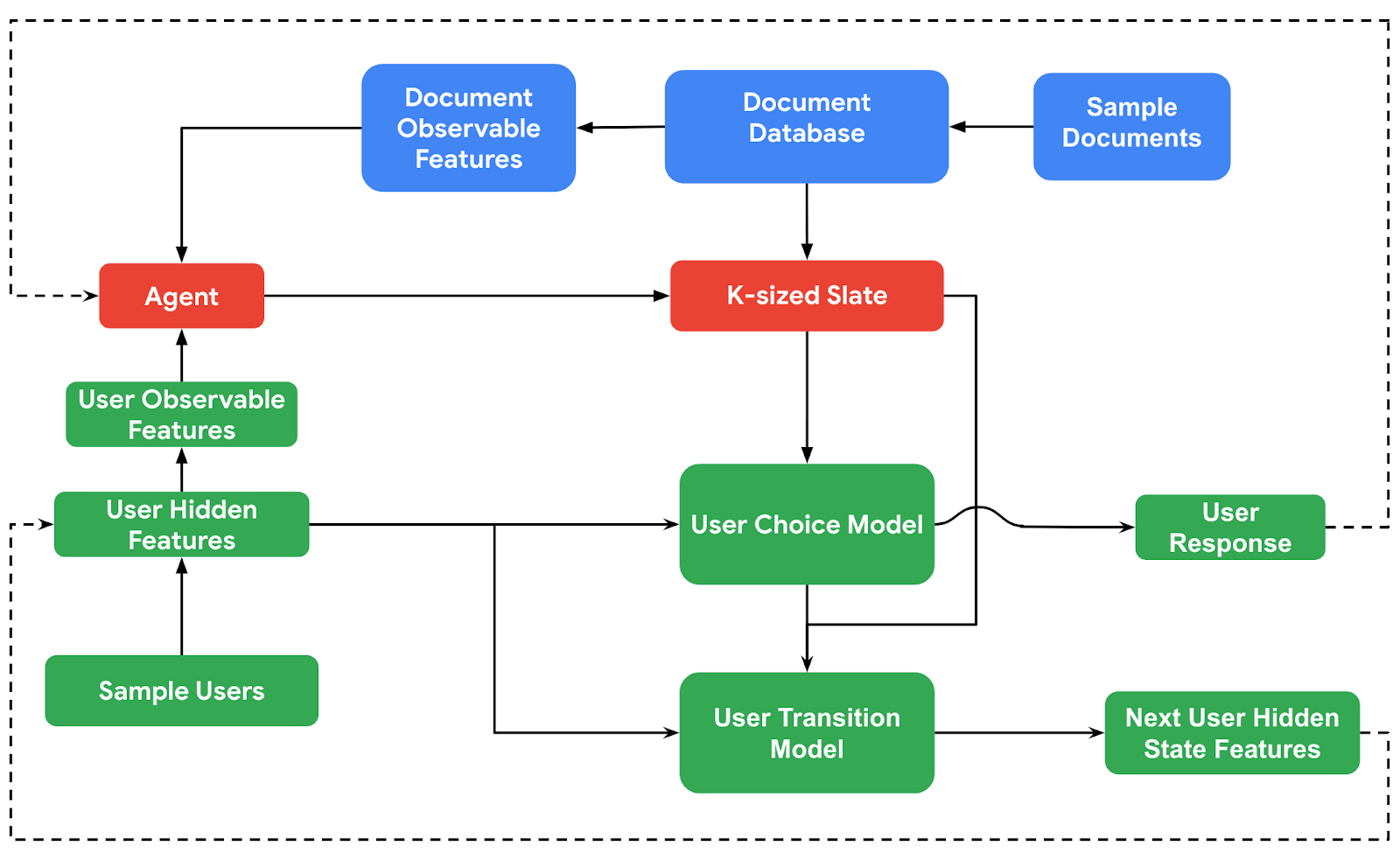
RᴇᴄSɪᴍ simulates a recommender agent’s interaction with an environment consisting of a user model, a document model and a user choice model. The agent interacts with the environment by recommending sets or lists of documents (known as slates) to users, and has access to observable features of simulated individual users and documents to make recommendations. The user model samples users from a distribution over (configurable) user features (e.g., latent features, like interests or satisfaction; observable features, like user demographic; and behavioral features, such as visit frequency or time budget). The document model samples items from a prior distribution over document features, both latent (e.g., quality) and observable (e.g., length, popularity). This prior, as all other components of RᴇᴄSɪᴍ, can be specified by the simulation developer, possibly informed (or learned) from application data.

The level of observability for both user and document features is customizable. When the agent recommends documents to a user, the response is determined by a user-choice model, which can access observable document features and all user features. Other aspects of a user’s response (e.g., time spent engaging with the recommendation) can depend on latent document features, such as document topic or quality. Once a document is consumed, the user state undergoes a transition through a configurable user transition model, since user satisfaction or interests might change.

We note that RᴇᴄSɪᴍ provides the ability to easily author specific aspects of user behavior of interest to the researcher or practitioner, while ignoring others. This can provide the critical ability to focus on modeling and algorithmic techniques designed for novel phenomena of interest (as we illustrate in two applications below). This type of abstraction is often critical to scientific modeling. Consequently, high-fidelity simulation of all elements of user behavior is not an explicit goal of RᴇᴄSɪᴍ. That said, we expect that it may also serve as a platform that supports “sim-to-real” transfer in certain cases (see below).
Data Flow through components of RᴇᴄSɪᴍ. Colors represent different model components — user and user-choice models (green), document model (blue), and the recommender agent (red)

Applications

We have used RᴇᴄSɪᴍ to investigate several key research problems that arise in the use of RL in recommender systems. For example, slate recommendations can result in RL problems, since the parameter space for action grows exponentially with slate size, posing challenges for exploration, generalization and action optimization. We used RᴇᴄSɪᴍ to develop a novel decomposition technique that exploits simple, widely applicable assumptions about user choice behavior to tractably compute Q-values of entire recommendation slates. In particular, RᴇᴄSɪᴍ was used to test a number of experimental hypotheses, such as algorithm performance and robustness to different assumptions about user behavior.

Future Work

While RᴇᴄSɪᴍ provides ample opportunity for researchers and practitioners to probe and question assumptions made by RL/recommender algorithms in stylized environments, we are developing several important extensions. These include: (i) methodologies to fit stylized user models to usage logs to partially address the “sim-to-real” gap; (ii) the development of natural APIs using TensorFlow’s probabilistic APIs to facilitate model specification and learning, as well as scaling up simulation and inference algorithms using accelerators and distributed execution; and (iii) the extension to full-factor, mixed-mode interaction models that will be the hallmark of modern CIRs—e.g., language-based dialogue, preference elicitation, explanations, etc.

Our hope is that RᴇᴄSɪᴍ will serve as a valuable resource that bridges the gap between recommender systems and RL research — the use cases above are examples of how it can be used in this fashion. We also plan to pursue it as a platform to support academic-industry collaborations, through the sharing of stylized models of user behavior that, at suitable levels of abstraction, reflect a degree of realism that can drive useful model and algorithm development.

Further details of the RᴇᴄSɪᴍ framework can be found in the white paper, while code and colabs/tutorials are available here.

Acknowledgements
We thank our collaborators and early adopters of RᴇᴄSɪᴍ, including the other members of the RᴇᴄSɪᴍ team: Eugene Ie, Vihan Jain, Sanmit Narvekar, Jing Wang, Rui Wu and Craig Boutilier.

By Martin Mladenov, Research Scientist and Chih-wei Hsu, Software Engineer, Google Research

Dopamine 2.0: providing more flexibility in reinforcement learning research

Wednesday, February 6, 2019

Reinforcement learning (RL) has become one of the most popular fields of machine learning, and has seen a number of great advances over the last few years. As a result, there is a growing need from both researchers and educators to have access to a clear and reliable framework for RL research and education.

Last August, we announced Dopamine, our framework for flexible reinforcement learning.  For the initial version we decided to focus on a specific type of RL research: value-based agents evaluated on the Atari 2600 framework supported by the Arcade Learning Environment. We were thrilled to see how well it was received by the community, including a live coding session, its inclusion in a recently-announced benchmark for RL, considered as the top “Cool new open source project of 2018” by the Octoverse, and over 7K GitHub stars on our repository.

One of the most common requests we have received is support for more environments. This confirms what we have seen internally, where simpler environments, such as those supported by OpenAI’s Gym, are incredibly useful when testing out new algorithms. We are happy to announce Dopamine 2.0, which includes support for discrete-domain gym environments (e.g. discrete states and actions). The core of the framework remains unchanged, we have simply generalized the interface with the environment. For backwards compatibility, users will still be able to download version 1.0.

We include default configurations for two classic control environments: CartPole and Acrobot; on these environments one can train a Dopamine agent in minutes. When compared with the training time for a standard Atari 2600 game (around 5 days on a standard GPU), these environments allow researchers to iterate much faster on research ideas before testing them out on larger Atari games. We also include a Colaboratory that illustrates how to train an agent on Cartpole and Acrobot. Finally, our GymPreprocessing class serves as an example for how to use Dopamine with other custom environments.

We are excited by the new opportunities enabled by Dopamine 2.0, and look forward to seeing what the research community creates with it!

By Pablo Samuel Castro and Marc G. Bellemare, Dopamine Team
.